


|
|
|
A
A Press
A printing press at the Bureau of Engraving and Printing. The press, capable of producing up to eight colors (five-color gravure and three-color intaglio), has produced a number of single-color definitives in the Transportation coil and Great Americans series, as well as a number of commemoratives and airmails, such as the 36-cent Igor Sikorsky. The A Press, actually designated press 702, was obtained by the BEP in 1973.
During the time the early line-engraved Queen Victoria issues were being produced in Great Britain, it was standard practice to produce six preliminary sheets for each new plate. One of these sheets was kept for archiving purposes, and the remaining ones were frequently processed, perforated, and released. Many such issues differed from the normally released ones in color, watermark, paper, or even perforations. Because the quantities of these "abnormal" stamps were so limited, they were immediately considered highly collectible rarities.
Any type of supply that aids a collector in his or her hobby. This can include hinges, mounts, albums, magnifying glasses, tongs, and scores of other items.
Acknowledgement of Receipt Stamp
A stamp used to pay the additional fee required by some countries for return-receipt service. In some countries, such as the United States, this fee is paid with regular postage stamps.
Any stamp-like item that is affixed to a letter or document to represent payment of postage or duties. Adhesives can range from Penny Black to city or local revenue stamps and all categories in between. Postal stationery, such as stamped envelopes, postal cards, and revenue stamped paper are not considered adhesives because the stamps are printed on, rather that affixed. Adhesive also refers to the gum or other mucilage used to affix the stamp itself.
A derivative of "ads on." Refers specifically to the 1893 stamps of New Zealand that were printed with various advertisements on their backs. These ads promoted a number of products, from the relatively unknown to Cadbury Chocolates and other well-known brands.
Adstamps
This was a short-lived United States innovation in the mid 1980s, where stamps were affixed to an advertising collar that could then be affixed to the envelope. Some samples were used for publicity purposes, but their use was quickly discontinued.
Ornate, printed advertising surrounding the area of an envelope intended for the placement of postage. These collars, most commonly collected on full covers, provided the advertiser with a handy way to peddle his goods. In many cases, the advertisement visually agreed with whatever postage stamp was current. Despite the widespread use of advertising collars, the practice was short-lived and eventually prohibited by postal regulations. The idea refused to die, however, and has been dredged up several times during the past century.
A cover prepared by a commercial source, such as a retail business or manufacturer, that includes advertising copy or illustrations promoting a product. The most desirable covers are those that are elaborately illustrated (especially in color), and those that represent some industries (such as gun making) that have captured the fancy of collectors or have strong topical appeal.
Advertisements on Stamps
A theory that advertising may be placed on the gum side of a stamp to get the message to postal users (a concept that has never really worked). The concept was tried on the 1/2-pence Great Britain stamps of 1887 and the 1-pence stamps of 1881. The backs were overprinted "Pear's Soap," over the gum, but their postal use was never allowed. They do exist in collector hands and are prized.
The idea of including advertisements in postmarks is almost as old as stamps themselves, but the actual practice has been slower in catching on; however, it is this concept that allowed slogan cancels, which are used all over the world, to flourish. In 1963, the British Post Office launched a program where resorts could promote their benefits in cancellations for a fee. Many resorts took advantage of the program, and numerous resort cancels exist. During the early 1900s, the British Post Office began using jet-sprayed advertising postmarks to promote everything from Kit-Kat candy bars to movies and theatrical productions.
Official Universal Postal Union name for airmail lettersheets created for international use. Such lettersheets are made from lightweight paper to minimize bulk, and they frequently enjoy reduced postal rates. They are known to have been used as early as 1933 (in Iran), but their widespread use came during and after World War II. Aerograms may be pre stamped or have adhesive stamps added and are not permitted to have enclosures.
Aerophilately
The collection and study of items related to all phases of airmail, from the stamps themselves to covers and studies of rates and routes.
A type of automation that allows mailers to have stamps placed on envelopes by machine. Forms of these machines date back to the 1850s, but they did not become standard equipment until the early 20th century. Stamps affixed by machines often feature clipped or damaged perforations but are desirable on cover to show the use.
Agency
There are two philatelic meanings to this term. The first is a reference to a postal agency of one country's post office, operated in the territory of another, by special arrangement. The Morocco Agency of Great Britain (complete with overprinted stamps) is just one of many different examples. The second, and probably more commonly known, type of agency is the representative of one country's post office in another. Examples of this type of agency include Unicover, Inter-post and Inter-Governmental Philatelic Corporation, each of which handles the stamps of other countries at face value.
See Etiquette
Any and all postal matter carried by air, and stamps or posted stationery inscribed to prepay such service. The 1859 Jupiter balloon flight marked the first government-sponsored airmail, which continued with the 1870 Siege of Paris balloon mail. The first actual airmail wasn't carried by powered aircraft, however, until about 1908. Regular airmail flights in the United States did not begin until 1918. For modern collecting purposes, the term airmail narrows somewhat to designated airmail, because most modern mail travels by air routinely, with no special designation.
An uninked stamp, one from which all colors are omitted. An albino stamp may have a blind, intaglio plate impression embossed on its surface, which may permit identification of the stamp. A blank stamp results when all colors are omitted from a stamp printed by lithography or photogravure, and no intaglio blind impression occurs. For stamps printed by methods other than embossing or line-engraved intaglio, it is almost impossible to know a stamp is a true albino without a colored stamp attached to it. Albino stamps occur as a result of foreign matter adhering to the stamp paper, foldovers, or two pieces of paper traveling through the press a once (the bottom piece becomes the albino). Albino stamps are generally quite rare and are very desirable to collectors.
Embossed postal stationery with colorless stamps. Although albino envelopes are technically color-omitted errors, they are generally considered freaks. They are created when two or more pieces of stamped enveloped paper travel through the press at once. The top piece accepts both the embossing and the color, while the bottom piece receives only the embossing. The resulting ghost design can range in intensity from bold to nearly unrecognizable.
Describes any of dozens of ways to house a collection. Most collectors consider albums to be commercially printed pages (with printed spots for stamps), housed in a special binder and supplemented as necessary. Popular lines of albums in this country include Minkus, Harris, and Scott. A stamp album may also consist of a number of homemade pages ranging from blank paper to those containing intricate drawings or specialized descriptions of the stamps they include. The first stamp album created for collectors was published in France by a man named Lallier in 1862.
A fake, forgery, or fantasy. The term was coined during the late 19th century to refer to what was considered a flood of undesirable items. It was popularized by the Rev. R.B. Earee, who published a series of eight books on the subject in 1906, Album Weeds. The books were derived from a series of articles begun in 1871. Earee's work is still considered an essential reference in this collecting area.
Describes any of a number of different types of plastic, paper, and glassine envelopes used to enclose damaged mail for delivery. For many years, most damaged envelopes were simply rubber-stamped with the notation that items were damaged in mail handling, in most cases with the specific cause (such as fire or depredation). In rare cases of extreme damage, such envelopes were enclosed in larger envelopes and so marked By the mid 1980s, the United States Postal Service and other postal entities began using specially printed bags and envelopes to enclose such mail. Most of these modern-day ambulance bags carry a generic description of damage, rather than a specific auxiliary marking.
An Italian-made press at the Bureau of Engraving and Printing, acquired in 1970 to produce stamps by photogravure. The seven-color web fed press has been used as the workhorse press for the majority of all U.S. multicolored commemorative stamps since that time; it has also produced some aerogramme's. It is officially designated by the BEP as Press 601.
Printing inks derived from coal tar. Aniline inks were designed to be brightly colored for their day and are water-soluble. This made aniline inks desirable to stamp-issuing authorities, because attempts to remove cancels though rubbing or soaking would damage the stamps. Most stamps printed with aniline inks fluoresce under long wave ultra-violet, which aids as an identification tool.
Selections of stamps sent out to collectors to examine for a few days and purchase what they wish, returning the balance with payment for stamps kept. Although most approvals accompany some form of introductory gift requested by a collector, some companies send out unsolicited, or un requested, approvals. This practice is not only considered improper, but postal regulations allow recipients to keep unsolicited approval material without being liable for payment. For requested approvals, however, 10 days is the standard examination period. Many companies specialize in approval selections.
A form of rouletting where the slit is formed in a semi-circle. The paper is cut, not removed, in making an arc roulette.
Stamps bearing the various coats of arms of heraldic designs of different political entities as the central part of the stamp design.
A special adhesive known to collectors of U.S. stamps, which was released in 1898 and purported to be an actual stamp created by the War Department. The label was really privately produced and was never valid for postage. The design, which comes in four colors, closely resembles that of the 10-cent 1869 and bears the legend "Official Business Only."
A post office for Army units. Even overseas military unites receive and send mail through the United States Postal Service mail system. Each APO has its own cancel, identified by a special number.
Arrow Block A multiple of stamps, frequently a block of 4 or six stamps, with an attached margin that contains the arrow-shaped marking and line used to align pane separators and perforators. These arrow blocks are considered premium position pieces.
Stamps formatted for sale by automated teller machines (ATM's) now in use by many U.S. banks and financial institutions. To be suitable for sale through ATM's, self-adhesive ATM stamps and their backing sheets must conform precisely to the length, width, and thickness of the U.S. currency notes that these machines dispense. The first U.S. ATM stamps were stylized 25-cent Flag stamps printed on plastic film, used during a six-month test period in 1990 at 22 ATM machines operated by the First National Bank in the Seattle, WA, area.
A public sale in which stamps are sold to the highest bidder present. Most stamp auctions feature an auction catalog in which lots are described and illustrated. Although held with live bidders, most public stamp auctions depend upon mail and phone bidding as well.
An experimental postage program operated by the United States Postal Service in 1989-90. Autopost postage machines (a total of six) were capable of weighing items, calculating postage, and dispensing a thermal-printed self-adhesive stamp that could be used any time from any location. The experiment was called off after the temperamental machines received little use from anyone other than collectors. Two machines were located in Washington, D.C., two in Kensington, MD, and two temporary machines were set up in the Universal Postal Union Convention headquarters during the World Stamp Expo in late 1989. Today, all Autopost items are fairly scarce, but the special UPU items (identified by machine number) are rare and costly. The most commonly encountered Autopost items are mint sets of first-day-dated Autopost stamps from the Washington and Kensington machine numbers.
Computer-printed and vended variable-denomination postage labels produced in a small number of experimental self-service mail stations.The stamps include four small stars around a large computer-printed "USA" and a vertical fluorescent orange bar at the left edge of the label.
Any additional marking added to a cover other than the postmark. In most cases, auxiliary markings describe a delay in mail service, including fires, crashes, or simple delays. The most common auxiliary marking is the pointing finger "Return to Sender" marking.
Average relates more to centering than to overall condition of a stamp. A stamp that is described as average is typically off center and has perforations that touch the design. Average imperforates will have at least one side cut so the design touches the cut. Average-centered stamps usually sell for significantly less that catalog value.
Perhaps the earliest form of cancellation machine, this model was designed by J. G. Azemar, who introduced it in 1869 in England. The marking consisted of seven horizontal bars, with a central diamond bearing a letter and number. The machines' use was discontinued in 1873. There is evidence to suggest the machine was actually invented in Hamburg, Germany, by a man named Wilhelm Ree.
B
This all-intaglio printing press, acquired by the Bureau of Engraving and Printing in 1973 (and began use in 1976), was capable of producing three-color intaglio stamps. It was the workhorse for most of the Transportation coil and Great Americans series stamps. The press was officially designated as Press 701.
The name given to the early key type (1889-1900) used in Spain and its colonies, featuring a portrait of a young King Alphonso XIII.
Applies specifically to the 50-cent United States airmail stamp released for the 1933 Chicago World's Fair, which pictures the Graf Zeppelin (Minkus #A19, Scott #C18). Because the stamp is not part of the Graf Zeppelin set released in 1930, but does picture the dirigible and is a similar-sized stamp, it received the fondly given name Baby Zepp.
Back-of-the-Book
The term given to all stamps that appear in stamp catalog listings beyond those of general issues. This area includes, but is not limited to airmails, postage dues, revenues, postal stationary, late fee, registry, Christmas seals, locals, newspaper stamps and semi-postal's. Scott and Krause-Minkus catalogs list regular & commemorative issues in the front of their catalogs and the back-of-the-book issues are the special function stamps that follow, including airmails, postage due stamps, official stamps and many others.
Backprint
Refers to any type of printing or type that appears on the backside of a stamp. This can include everything from advertising, such as can be found on early stamps of New Zealand, to the printing on the back of U.S. Duck stamps. Backprint also is one of several unofficial terms used to describe some of the stamps that have been printed on the backs of other previously printed material, such as unfinished banknotes and maps. In 1919-29, the backs of unfinished sheets of banknotes were used for the production of postage stamps to save paper in Latvia. As a result, the backs of individual stamps show parts of engraved designs intended for currency.
A postmark applied to the back of an envelope. The primary purpose of a backstamp is to document the date, time, and receiving location of a specific mail piece. The practice of backstamping is still occasionally encountered but was officially abandoned in the United States early in the 20th century.
On-paper mixture supposedly collected from the incoming mail of various banks and financial institutions. By their nature, bank mixtures tend to contain large numbers of definitive or regular issues, but can also contain the odd high-value stamp as well. If advertised as a worldwide bank mixture, such items can contain a wide variety of worldwide stamps.
In 1919-21, Latvia used the reverse side of old, unfinished currency and maps to print its stamps. Thus, the back sides of these stamps show partial bank notes.
Describes versions of regular-size miniature stamps from different countries, particularly the war-effort and war tax stamps of South Africa.
An encrypted series of long and short vertical lines (essentially using the binary system), applied to envelopes by an ink-jet printer to allow high-speed computerized machinery to read a five-, nine-, or 11-digit ZIP code. Such markings also may be printed on the envelopes by private mailers.
A printed form of defacement sometimes used as a way to change a stamp's denomination or design. In some cases, stamps that are remaindered are defaced with bar markings before being sold to stamp dealers. In other cases, bar markings are used to obliterate an old denomination or unwanted design element prior to overprinting stamps with the new information.
Battleship revenues are two series of documentary and proprietary revenue stamps released in 1898, during the Spanish-American War. The name comes from the stamp design that pictures the Maine, which was sunk in Havana Harbor and kicked off the war.
A type of paper upon which stamps have been occasionally printed. Battone resembles laid paper, except the lines are further apart and there are crossing lines as well at regular intervals.
A complicated group of special-purpose stamps released between 1866 and 1951. These stamps were affixed to kegs and barrels of beer and, later, fermented malt liquor. Like many revenue stamps affixed to items, instead of paper, damaged copies are the rule rather than the exception.
A form of solvent used for many years by collectors to view the watermarks on stamps; however, benzine is extremely flammable, its fumes are harmful, and it damages certain types of stamps (such as those printed by photogravure).
Stamps released to celebrate the 200th anniversary of an event. The most well known of these is the extensive series of stamps released by numerous countries during the United States' 1976 bicentennial celebration. Bicolor Refers to a stamp printed in two colors.
Bicycle Mail
Any mail carried or delivered by bicycle. The most well-known bicycle mail was carried by Arthur C. Banta in 1894, during the San Francisco mail strike. Special adhesives were issued for the service as well, and these stamps (and covers) are quite rare and desirable. Lesser-known bicycle mail also was carried in Australia, which was established to transport mail between Kalgoorlie and the nearby gold mines.
Single stamps bearing the inscriptions of more than one language, such as those of Canada (English and French).
An un separated pair of stamps inscribed in two languages. The best known of these are the numerous issues of South Africa and Southwest Africa, where the languages are English and Afrikaans.
Bisect
A stamp that has been cut in half horizontally, vertically, or diagonally to pay a rate for which no stamp is available, usually through a shortage of stamps at the post office. Both halves of bisected stamps are used. For example, a 10-cent stamp may be bisected to create two 5-cent stamps. Such items are created out of need and often are scarce. Due to their nature, however, bisects are considered valid only when tied by cancel to a cover or piece representing the proper rate. Bisects are no longer legal in the United States, although they are occasionally done as novelties, usually by collectors. Bishop Mark Describes the earliest postmark, devised by Englishman Henry Bishop, considered to be the first Restoration Postmaster General. These markings indicated the day and month a mail piece was received at a post office. Although it is not known exactly when Bishop introduced this revolutionary marking, the earliest-known examples date from May 1661. Bishop was well aware of the importance of his marking. He wrote: "A stamp is invented that is putt upon ever letter shewing the day of the month that every letter comes to the office, so that no Letter Carryer may dare detayne a letter from post to post; which before was unusual." Bit In the papermaking process, a bit is the small piece of wire or metal on the dandy roll that creates the watermark. The term also refers to a currency unit of the Danish West Indies from 1855-1917. Black Blot One of several forms of universally failed attempts at philatelic censorship. The name Black Blot, which is now used generically, has been used several times. The motive behind such programs is pure, but the effort itself is fundamentally flawed. The Black Blot program, most recently attempted by the APS during the 1960s and '70s, identified stamp issues and countries felt to be speculative or bogus in nature. The goal was to then shun these stamp issues to keep collectors from "throwing away" their money; however, if the program were ever successful, such black-blotted issues would become scarce and, later, costly and desirable. If the effort fails, these programs do little more than to publicize the very issues they wish to squelch. Blackjack
A form of postal marking used in Canada during World War II as a security measure. Affected machine cancel town marks had the town name removed to conceal mailing locations, particularly for post offices with military personnel near either coast.
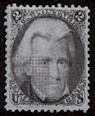
Example of a "Blackjack"
Blanket Currently refers to the rubber surface upon which an offset image is transferred from the printing plate prior to being applied to the stamp paper. Bleute A French term related to the bluish paper found on early British issues.Blind Perfs A freak in which perforation holes are not completely punched through the stamp paper. This condition ranges from partially penetrated holes to cases in which there is no visible evidence of perforations other than perf pin indentations on the front or back. In some cases, blind perfs may affect only one or two holes on a stamp, but in more severe cases, blind perfs can give the impression of a completely imperforate or imperforate-between error. Blind perfs are not to be confused with missing perf errors, in which absolutely no traces of the perforation process are present. Stamps with blind perfs are collected by those who specialize in errors, freaks, and oddities and sell for significantly less than true imperforate errors. Block
A multiple of four or more un separated stamps that forms a square or rectangle. Unless the size of a block is specifically indicated the term applies to a block of four. Blocks are collected in plain, with no selvage, or with various marginal markings or imprints. These are usually referred to by name, such as plate or inscription blocks. Although the preference is for clean, even (symmetrical) blocks, odd numbered or ragged blocks are collected for scarce classical material.
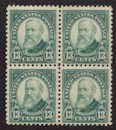
Example of a "Block" of four stamps
Block Tagging A form of phosphorescent tagging, also known as block-over-vignette. Block tagging involves the application of individual squares of taggant over the stamp design area done to protect perforating and processing equipment from the abrasive nature of taggant material.Bluish Paper In 1909, the Bureau of Engraving and Printing experimented with paper containing 35 percent rag stock instead of all wood pulp. Several stamp, including the 1909 Lincoln commemorative and several values of the Washington-Franklin series, were printed on this paper. The resulting appearance of the stamps is a pale bluish color. All bluish paper stamps are scarce and should be expertised before purchasing. Boardwalk Margins Term used to explain the abnormally large-sized margins that appear on some stamps. Named after the old style of wide sidewalk, boardwalk margins are created unintentionally by wide settings of perforation. Boating Stamps Boating stamps were used during the early 1960s on applications for the certificate number of 10-horsepower and larger motorboats. BOB The often-confusing abbreviation for back-of-the-book, which includes everything from airmails to revenues (all material usually physically listed in the back of stamp catalogs, beyond the postage listings). Bogus Describes stamp-like items from real or imagined countries, usually created by those who hope to sell them to unwary collectors as genuine postal issues. Such stamps can bear a very close resemblance to real issues, whereas others are pure fantasy. In some cases, bogus values have been added to legitimate sets of postage stamps. Booklet Stamps bound or folded within stiff covers, giving the appearance for which it is named. Small panes of stamps sewn, stapled or glued between relatively stiff, thick covers (or increasingly with recent self-adhesive stamps, on tough backing paper that may be folded into a booklet when the stamps are purchased). Stamp booklets were devised as a convenience to stamp users for easy parrying of stamps. In 1895, Luxembourg became the first country to release stamp booklets by breaking sheets down into individual panes and forming them into booklets. Other countries, including the United States in 1900, soon followed suit. Over the years, booklets have taken many forms, ranging from stapled panes to the aforementioned foldable self-adhesive booklets. Booklet covers typically enclose one or more booklet panes, which may or may not have non-postal labels se-tenant with the stamps. Older booklets may also have paper or glassine interleaving, or protective pages, with or without text, between each booklet pane of stamps. In most cases, each booklet pane is attached to the booklet by a binding stub at one edge of the pane. Such stubs may be stapled, attached with their own adhesive or bound by other means. A booklet carefully dismantled and displayed to show all of its parts - the covers, the panes, the interleaving, and the binding, if any is called an exploded booklet. Most booklets contain more than one small pane of stamps. Booklet Number Singles Until recently, plate numbers on U.S. booklet stamps could be collected only on the binding stub. But in early 1997, beginning with the Yellow Rose, the USPS began releasing some booklets with plate numbers printing on the stamp itself. This makes those stamps design-different and collectible. In the case of the Yellow Rose, the number singles are distinguishable between 15- and 30-stamp booklets by virtue of their straight edges.
Booklet Pane
A single page, or pane of stamps from a complete booklet of stamps. Panes may be collected separately from booklets. Such panes are said to be from an exploded booklet. Depending upon how they are produced, booklet panes may have staple holes or folds and many may be found either or without binding stubs. Panes missing binding stubs generally are worth far less than those with stubs. On earlier issues, particularly from the United States, plate numbers are found only on certain positions from the printing sheet and command a premium over standard value.
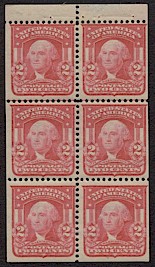
Example of a "Booklet Pane"
A letter carried outside the official mail stream. Sometimes, especially in early postal history, this would happen for many reasons. If a friend was going to another country, for example, it might be cheaper to have your friend take your letter and put it into the mail when he reached his destination. The cover would be datelined with the country of origin but would have the domestic postage of the country that received it into the mail. Therefore, it would be written from Russia in 1850 but have a 3-cent United States stamp for postage and have a New York CDS.
Border
The outer printed edge of a stamp or pane design. A border may be as simple as a frame line surrounding the inner design or as complex as ornately engine-turned engraving.
Bourse
Any organized meeting of stamp dealers or collectors where stamps are bought and sold. Bourses may be part of a stamp exhibition, where collections are competitively shown, or they may be independently held.
A postmark printed with a frame surrounding the text. Boxed postmarks may be single-, double-, or triple-lined, have one or more lines of text, and be extremely ornate or very plain.
See Perfins.
Bridge
The paper between perforation holes that holds a multiple of two or more stamps together.
Broken Set
Any group of stamps from an issued set that is missing one or more values. A broken set, when advertised as such, usually means that all inexpensive stamps from the set are present, but not the scarce or expensive ones.
Buggy Whip
A popular plate variety found on the 4.9-cent Buckboard stamp of the United States Transportation coil series. The variety is a plate crack caused by the grippers that held the curved plate onto the press. When the plate cracked, it did so extending from the seat of the Buckboard upward. As a result, ink gathered in the crack and printed out on the finished stamps. The name refers to the appearance of the crack, which resembles a buggy whip. Because the crack is a constant plate variety, all stamps from that plate in that position show the crack.
Bulk Mail
Type of mail commonly referred to as "junk mail." Bulk mail is sorted, bundled, and processed at various levels by the mailer in exchange for reduced postage rates. The classification encompasses numerous forms, including several mail classes, different levels of presorting, and non-profit status. Although all bulk mailers receive discounted postage rates, they earn those discounts. Many of these different rates are represented by fractional-denomination postage stamps. Many collectors save bulk mail stamps and study the postal history connected with them.
Bull's Eye
Also known as socked-on-the-nose. Refers to canceled stamps with the circular portion of a hand stamps or machine cancel nearly perfectly centered on the design area of the stamp itself. Bull's-eye cancels may be collected by date, type, town and many other ways. Many collectors of bull's-eye canceled stamps form calendar collections with a stamp for each day of the year. The term also applies to early issues of Brazil that somewhat resemble a bull's eye.
A stamp with the entire circular-dated portion of the cancel appearing in the design area. The date of the cancel of such an item is the first-day release date of the stamp. The collecting of Bull's-Eye first-day canceled stamps is a specialty.
Bureau of Engraving and Printing (BEP)
The BEP is a branch of the Unites States Treasury Department and has been the primary printed of U.S. Stamps since 1894. During most of those years, the BEP was the only printer, but contract printers began taking work from the bureau as early as the 1970s, escalating throughout the 1980s and 1990.
Bureau Precancel
As it relates to stamps of the United States, this type has been precanceled at the source by the stamp printer, usually the Bureau of Engraving and Printing. These are set off primarily because the cancellation has been applied by one of the color stations on the stamp printing press. The superior quality of the printing usually distinguishes bureau precancels from local precancels.
Burelage
A fine regular pattern of lines, dots, or other graphics printed on the face or the back of a stamp as a security device to help discourage cancellation removal or counterfeiting. If the burelage is printed on the back of a stamp, it is usually done before gumming, but if it is on the face, it usually is applied before printing and appears under the printed stamp design.
Burr
A raised bit of metal on a die or plate, a burr can be caused by an engraving tool or by damage to a printing plate. If a burr is not properly removed from the plate before printing, it can become visible as a constant plate variety.
A type postmark used on the first issues of Victoria. The marking shows a double, concave line on two sides (resembling a butterfly's wings), a post office number forming the letter head, and the letter "V" forming the tail. These cancels are highly prized by specialists.
C Press
A three-color, web fed intaglio press utilized by the BEP (obtained in 1982) to print numerous definitive issues of the 1980s and 1990s. The press was officially designated as Press 901.
Cachet
A design on an envelope, most frequently a first-day cover. Although they are primarily illustrative in nature, cachets can be completely composed of text. The term is also less frequently applied to any illustration on a commercial cover, including advertising that is increasingly important to the value of the cover. In fact, cachets created by certain artists, individuals or companies frequently sell for may time the value of standard FDCs. Cachets may be applied in any number of ways, including by rubber stamp, printing, drawing or painting. A cachet can even be a special label or photograph created for an event or issue.
Stamps that have been canceled without having served postal duty. This is frequently done by postal agencies with their remainders, before selling them to stamp dealers for the packet trade. Some countries that rely heavily on stamp collector income order a certain number of canceled-to-order stamps along with the standard print run. CTOs may appear with hand, machine, or printed cancels, and the cancels frequently have a rather uniform appearance. Most CTO stamps are worth considerably less than their postally used counterparts, but many catalogs list used values based on CTO, rather than postally used stamps. Many CTO stamps have full gum, even though they are canceled. Despite their low esteem through the hobby, CTOs provide collectors with inexpensive, highly collectible stamps in generally excellent condition.
Cancellation
Any form of stamp defacement applied to prevent revenue loss through illegal reuse of stamps. Although cancellations are most commonly encountered as ink obliterations, they also can be holes, cuts, tears or even laser burns. While any for of cancellation is legitimate, collectors deem some forms highly desirable (such as fancy cancels) and others undesirable (such as ballpoint pen), which can have a vast influence of the value of a used stamp.
A very volatile and dangerous fluid that was marketed for many years to stamp collectors as a watermark fluid. Although it was effective for viewing watermarks and detecting repairs, the hazards outweighed the benefits. All use of this hazardous material was halted in the late 1960s after its use was connected to cancer.
Carrier Stamps
Stamps (and similar markings) used in the United States from 1842-60 to pay the delivery fee on items from the receiving office to the recipient, or from one address to another within the same delivery area. At that time, postage stamps paid fees only from one post office to another. Two basic types of carrier stamps exist: official and semi-official. Official carrier stamps were produced by the government, while semi-officials were privately produced but sanctioned by the local postmaster. After the discontinuance of carrier fees June 30, 1863, all letter carriers were government employees. The United States is one of few countries to ever have used carrier stamps.
Catalog
A priced list of stamps, covers or other philatelic material. Although there are only a few dominant catalogs, many different types exist, each an important reference for stamp collectors. A catalog may be as simple as a small price list or as elaborate as a multi-volume set of books.
Catalog Number
The identifying assigned to any individual stamp or set by the catalog publisher. The numbers may be either strictly numerical or alphanumeric, a combination of letters and numbers.
Catalog Value
A value placed upon a stamp by catalog publishers. The values may reflect the true market value of a stamp or be a more general price guide. In most cases, a minimum catalog value is assigned to common stamps of little real value to represent the cost of time involved to individually price and stock common stamps for sale to collectors.
Abbreviation for the circular date stamp.
Censored
Any cover or mail that has been opened, read, and altered to conform politically or informationally. Most censored covers are created during wartime to stem the flow of vital information. Censored covers generally feature a marking or special tape, or both, applied by officials opening the mail.
Released to mark the 100th anniversary of an event or the 100th birth anniversary of an individual.
Refers to the placement of the stamp design in relation to the perforations or edges of a stamp. The more perfect the centering (and the larger the margins), the higher the stamp's grade. The more off center the design, the lower the grade to the stamp. Centering plays a very important role in valuing stamps. Many catalogs value stamps in fine to very fine centering - the condition in which most stamps are encountered by collectors. Other catalogs value stamps in very fine condition, a higher quality and less frequently encountered centering, which is worth more. Stamps with nearly perfect centering (superb) frequently sell for multiples of catalog value, while those that are quite off-center (but not misperforated) sell for far less than catalog value. Although centering alone plays a large role in determining the value of a stamp, it does not take into consideration any faults a stamp may have; therefore an undesirable damaged stamp may have superb centering, but may be worth a small fraction of its catalog value.
Unit of measurement in the metric system, where 100 centimeters (2.54 to the inch) equal one meter. In stamp collecting, perforation measurements rely on how many perforation holes are contained in a 2-centimeter area. Thus a stamp that gauges 10.5, for example, would have 10-1/2 perforation holes in a 2-centimeter length.
Ceremony Program
See First-Day Ceremony Program.
Certified Mail
A first-class mail service for which the sender receives a receipt certifying that an item has been mailed. If desired, and for an additional fee, the sender may also receive a return receipt, signed by the recipient. Although there is no compensation for loss, certified mail does provide proof that an item was mailed. In the United States, the service has been available since 1955, but only one stamp has been released specifically to pay the fee. Covers bearing certified markings and the appropriate postage are prized by postal history collectors.
The technical term given to the little bits of paper punched out during the perforating process.
Chalky (or coated) Paper
A special form of security paper, true chalky paper has a layer of chalk on its surface upon which the stamp image is printed. The surface not only makes for a clean stamp image, but any fraudulent attempt to remove the cancellation from a chalky stamp (including soaking) results in the removal of the chalk layer, including the stamp design.
Several British countries released postage stamps bearing the famous portrait of Queen Victoria painted by Alfred Edward Chalon in 1837. The first stamp to utilize this portrait was the 12-pence Canada stamp released in 1851. Stamps with this portrait are frequently referred to as Chalons.
Chameleon Paper
A special form of security paper utilized to prevent illegal reuse of revenue stamps on documents. One of the components of chameleon paper is pigmentation that changes with attempts to remove the cancellation.
Another term for a semipostal stamp. A semipostal is a postage stamp that is sold by the post office at an amount higher than face value, with a portion of the proceeds going to a designated charity. Most semipostals express their face value additively, as in "45pf + 15pf," indicating a 60-pfennig stamp of which 45pf pays postage and the remaining 15pf is a contribution to a designated charity.
Check Letters
Letters positioned in the corners of many British stamps to indicate the location of a stamp in the original sheet. Check letters were used to help prevent the forgery of stamps. As they affect collectors, check letters, combined with printed plate numbers, help to fully identify stamps and their positions in the original sheet. The letter in the upper-left corner identified what vertical column contained the stamp, while the letter in the upper-right corner indicated the horizontal row. Thus, a stamp with letters "C" and "Q" would indicate the stamp from the third vertical column, and the seventeenth horizontal row.
Chewing Gum Booklet
A somewhat tongue-in-cheek moniker given to some small booklets of stamps produced by Canada from 1943-53. These tiny booklets, about the dimensions of a stick of chewing gum, contain panes of three stamps each, with natural straight edges at the top and boom (and on the right side of the end stamp). Because of their odd appearance, stamps from these booklet panes are often mistakenly put aside by collectors and dealers as coil stamps. Chewing gum booklets were initially created during World War II to conserve resources and to fit into quarter vending machines.
Chill Rollers
These are special rollers on some presses that help cool the web after the stamps have been printed, often to prepare the web for another step, such as tagging. These chill rollers occasionally pick up ink from the printed stamps and deposit it on others, creating what collectors refer to as chill roller doubling.
Chop
A marking consisting of Japanese or Chinese characters that have been overprinted, hand-stamped, handwritten, or otherwise applied to stamps and covers. Chops were used extensively in the territories occupied by the Japanese during World War II. Such markings were provisionally used to create occupation stamps until new stamps could be printed and distributed.
Christmas Seal
A non-postal label, created by various charities and sold or distributed (for a requested donation) to people for use on outgoing holiday mail. Seals may be found anywhere on an envelope, but are most desirable when positioned near a stamp and tied by a postal cancel. The first U.S. Christmas Seal was issued in 1907.
Chroma
The brightness of a color. A high-chroma color is very intense and pure, while a low-chroma color is very dull in appearance.
Chromed
The hardened state of modern printing sleeves. After the metal is hardened, a coating of chrome is applied to help the printing sleeve have a longer printing life. Chromed printing sleeves may be rechromed.
Cigarette Tube Stamps
These served as receipts for taxes paid on tubes of hollow cigarette paper sold to people who made their own cigarettes.
Cinderella
Any collectible stamp-like item that isn't a postage stamp. This area defined differently by many, can include revenue stamps, local post labels, Christmas and other charity seals, test labels, and a host of other items. Although some collectors specialize in cinderella material, many enjoy adding cinderella's to their existing topical or thematic collections or other specialized collections.
Circular Date Stamp (CDS)
The circular marking which feature the date and the name of a town. It can also have the country and the time as part of the CDS. In modern times, it can include an APO (Army Post Office) or FPO (Fleet Post Office) number.
Classic
Any stamp, postal stationary or other postage or revenue item that has gained a particular position of distinction among collectors. Most classics, however, are considered to be at least 100 years old. Such stamps have gained universal acceptance and popularity, due to their longevity. Although many classics are quite rare, not all stamps considered classics are expensive.
Cleaned
A canceled stamp that has had the cancel or other marking removed, usually to be fraudulently sold as an unused stamp.
Cliche
An individual stamp image on a printing plate. More specifically, the term applies to a cast block representing a partial plate, usually used in connection with letterpress printing. Coarse Perforations Refers to any stamp with large holes and perforation teeth far apart.
Coarse perforations
are found on stamps of many different countries, often combined with crude forms of perforation.
Coil Stamp
Coil stamps are those issues usually released in a long strip or roll format. Such stamps are generally created for use in automatic vending and affixing machines. Coil stamps are easily identified from sheet-stamp counterparts. United States coils posses straight edges on two opposite sides and perforations on the remaining two sides. Coil stamps of other countries, such as Great Britain, may be perforated on all sides, but may be identified by watermarks or other distinguishing features. Early coil stamps are usually collected in pairs as an identification and verification aid.
Coil Wrapper
The seal, label, or wrapper used by stamp printers to package or finish completed coil rolls. Although these items were intended to be removed from coil rolls and discarded, they have become a specialized colleting area, either as an adjunct to coil collecting or as part of a study of stamp printing and processing.
Collateral Material
Any literature, photographs, maps, or other material that is relevant to a specialized stamp collection or exhibit. In most cases, collateral material is not desirable in exhibits seeking awards, but it can be very helpful to the casual viewer or the researcher.
Collect
Half of one type of telegraph stamp that was affixed to and sent with a telegram. The copy kept in the office had a 'duplicate' stamp affixed. Both types were printed se-tenant on a single sheet.
College Stamps
Labels resembling postage stamps created for use in business colleges to teach mailing and mail handling practices. Such cinderella's are highly sought after and avidly collected. Another form of college stamp is a type of adhesive used to prepay fees for delivery of mail matter with their messenger services. The most well-known of these are Oxford and Cambridge Universities in England (1871-86). Use of these stamps was discontinued at the request of the British postmaster general.
Color Changeling
A stamp of which the colors have been altered or eliminated by physical or chemical tampering. Certain stamp dyes are susceptible to alteration, especially bleaching by sunlight, heat or chemicals. Color changelings do occur naturally, as in the case of sun bleaching, and they occur as a result of chemicals and other substances that have come into contact with stamps. Color changelings have little philatelic value, except as novelties.
Color Guide
A printed set of color swatches used by collectors to match stamp colors used to print stamps. Such guides are usually printed on coated paper, with currently available. A collector then matches the stamp against the swatches to identify shades. Un fortunately, because color is perceptual and different inks aged differently, there has never been a truly accurate color guide, nor is there likely to be one. Color guides can prove useful, however, to help collectors identify basic shades used on stamps.
A stamp in which one or more colors of ink have been completely omitted. To be considered a color-omitted error, 100% of the affected color or colors must be absent on a stamps.
Color Shift
Also known as misaligned or misregistered color; occurs when one or more of the plates used to print multi-colored stamps is out of register with the other colors, or when sheets ore fed incorrectly on one or more of multiple passes through the press. Color shifts make up a form of stamp printing freak possible only with multicolored stamps. Most multicolored are printed using variations of red, blue, yellow, and black. The combination of these hues and black forms the illusion of any color in the spectrum. To achieve this illusion, images must be separated by color and each is produced by a separate on-press printing plate, sleeve or cylinder. In some cases this involves separate press runs (which is how inverts sometimes occur). Generally, multicolored printing is accomplished with different color stations on a single press. When any one color (or more) becomes misregistered, a color shift occurs. Depending upon how major the shift, variations are created in the stamp's appearance; thus, a stamp may look only slightly blurry, individual elements of design may appear to be doubled, or, where the color shift is dramatic, some features may appear quite bizarre. This freak may occur on many stamps or only a few. Although these misregistered freaks are highly collectible, most do not sell at the price level of true errors, such as missing colors or inverts.
Color Smear
A broad category of freak items that includes any unintended color that appears on a stamp as a result of a printing fluke. Color smears may be very small and insignificant, affecting a single stamp or they may be very noticeable and affect a full pane.
Color Trials
Proofs of a stamp design, printed in different colors to select the final, most suitable, color of a stamp. Also known as trial color proofs.
Column
A vertical, single-stamp-width multiple of stamps from a sheet, pane, or booklet.
Comb Perforations
A type of perforation is named for its appearance. Comb perforations are repeating rows of one horizontal and numerous vertical rows of perforations resembling a comb. This pattern is repeated across the sheet, forming final conventional-looking perforations.
Combination Cover
In its classic sense, a combination cover is one in which stamps from two or more different countries or stamp-issuing entities combine to pay the postage. Such covers were not uncommon in the early years of stamped mail, when international postal treaties were inconsistent. Today, the term also is sometimes used to describe a cover franked with stamps of more than one issue of a single nation. Stamps of the United States and Canada were used to pay the postage to London on this combination cover.
Commemorative Panes
A pane of stamps in which paper around the stamps (the selvage) has text, illustrations and a header printed across the top or other information about the stamps and what they commemorate. Unlike older commemorative sets in which each value was printed on a separate pane, commemorative panes are printed with the stamps se-tenant.
Commemoratives
Stamps issued to honor an individual, institution or event; almost all are denominated at the basic U.S. first-class letter rate in use at the time of issue. The are printed from a relatively small number of plates and are usually sold until stocks are largely depleted, at which time they are taken off sale. Although commemoratives are generally larger than definitives, they cannot always be determined by their size or even subject matter. Several countries lay claim to having produced the first commemorative stamp. The United States produced a 15-cent black Lincoln stamp in 1866, which is considered by some to be a mourning or commemorative issue. The 1869 series, the United States first pictorials, are considered by many to b the commemoratives. Peru issued a stamp in 1871, marking the 20th anniversary of the railway in South America. The 1862, Laureated stamps of France, showing a portrait of Napoleon III with a laurel, that represented Napoleon's victories in Italy were released. Although France claimed at one time these stamps were commemoratives, they are definitive in nature. Other late 19th century issues have been heralded as the first commemoratives, but the credit us usually given to the 1869 series or the Peruvian stamp.
Commercial Cover
To postal history specialists, a commercial cover is far more desirable than one that originated philatelically. A commercial cover is one that traveled through the mail for business purposes, such as to carry a gas bill or subscription payment. Some stamps, however, such as those created for sale to collectors, are virtually impossible to obtain on commercial covers.
Complete Set
A group of stamps that includes all values from a series or all stamps from a defined issue.
This term describes stamps with sides that have more than one gauge of perforation. The cause of such stamps can be intentional or accidental. A stamp with compound perforations may measure, 11 x 10½ or it may have three sides with one measurement and the fourth with a different type. Some triangular stamps are even know with three different gauges.
Computer-Vended Postage
Stamps sold by interactive vending machines, which allowed the user to select the desired denomination and print the stamp to order. Although some experimental types of U.S. computer-vended postage have come and gone, variable-denomination stamps with a red and blue shield motif printed by postage and mailing center machines produced by ECA GARD and Unisys were fairly successful, in limited use.
Condition
A postage stamp's overall state of being. For example, a stamp may be perfectly centered and feature a light cancel, but be in poor condition if it is torn or thinned. Generally, the description of a stamp's condition takes all factors including centering, cancellation, damage, color and others into consideration.
Condominium
An arcane term that describes stamps released by a territory that is governed by more than one entity. Such stamps may be bilingual, or they may be similar-looking stamps bearing the same denomination and separate country names.
Consummation (Papier de Grande Consummation)
A rather poor grade of granite paper used for French war-time stamp issues of 1917-20.
Constant
Although mat varieties are similar in definition to plate varieties, they affect only an overprint (the mat). Damage apparent on a mat will print consistently on stamps produced from it and will be consistent in appearance. If the sleeve size of an overprint mat is a different size than the printing plate of a stamp, the variety will appear in different positions on a sheet or coil, when gauged by sheet-counting standards.
Constant Plate Variety
A plate variety that is consistent through the printing of a stamp, from the time damage occurred to the plate until a stamp's press run is finished, or the damage is repaired. Some plate varieties become more pronounced with wear and tear on the plate. Because the damage is done to the printing plate itself, the resulting crack, gouge, or other marking will always appear on stamps printed in the same position from the same plate. If a stamp has been printed by line-engraved intaglio, plate varieties will appear as printed lines, cracks, or other shapes. If a stamp was produced by letterpress, plate damage appears in the form of un printed areas.
Those stamps affixed to various documents where consular officers of the United States showed payment of specific set fees for various duties connected with their offices.
Contingency Stamp
Control Mark
A letter, number, or symbol applied to a stamp or its selvage, usually for accounting purposes. The marking may be printed, hand-stamped, or even handwritten.
Controlled Mail
Many collectors use mail between each other as a form of controlled mail to obtain philatelic-quality used stamps that are difficult to obtain. Years ago, some large countries also participated in this practice, using high-denomination stamps and then selling the lightly canceled examples to stamp dealers, thus recouping some of their normal mailing costs.
A marking that appears on stamps applied by the end of a carved cork, an inexpensive form of cancellation device. Such cancellations were common the 1850s and 1860s. Some cork cancels are very basic, while others are intricate or fancy. Such cancels are prized by many collectors, may of whom collect these cancels.

Example of a "Cork Cancel"
A block of four or more stamps from the corner of a sheet or pane of stamps, complete with marginal selvage if it exists. Corner blocks may contain plate numbers, designer initials or other marginal inscriptions that make them more collectible that a standard block.
Corner Card
The printed return address of the sender in the top left corner of an envelope, also use to identify any envelope or item of stationery bearing such a marking. As with advertising covers, corner cards may be simple or highly elaborate.
Corrosion Stain
When moisture is left on a printing plate, it will begin to corrode the surface, as it would with any other form of metal. The corrosion leaves small water droplet-like impressions on the plate that retain ink when the plate is inked. The resulting marks print on the stamp paper itself. In most cases, corrosion stains are limited to the margin of a pane, but they are also known within the stamp area.
Cotton Reels
The common name given to the first issues of British Guiana in 1850. These blue, typeset, circular stamps received the nickname because of their similarity in appearance to the small labels applied to spools of cotton sewing thread.
Cottrell Press
From 1956 until the late 1980s, Cottrell Presses were the mainstay of postage stamp printing at the Bureau of Engraving and Printing. These presses were designed by the Huck Corporation and built by the Cottrell Co. (thus the name). Most stamps of the Liberty, Prominent Americans, Americana, Transportation, and Great Americans series, as well as numerous commemoratives, were produced on these presses. The BEP owned five of these presses, officially designated as presses 801, 802, 803, 804, and 805.
Counterfoil
The receipt half of a two-part stamp. Counterfoil issues are known mostly from European countries, such as Italy and San Marino, where the two-part stamps are usually parcel post issues. The intended use of counterfoil stamps is for one half to be affixed to the mail piece, with the other half being affixed on a receipt and retained by the sender. As a result, the most commonly encountered form of a used counterfoil stamp is as a half, although most halves have relatively little value. Used counterfoil entire's are scarcer and frequently command a premium price. Unused counterfoils are expected to be complete.
Counting Numbers
This term has two definitions. First, the Cottrell Press used them for printing coil stamps. At either the top or bottom of the web of paper, small numbers were engraved between plate numbers at intervals of four stamps. These numbers appeared below and above the fourth, eighth, twelfth, and sixteenth stamps. Because their location on the printing plates was so far away from the stamp image, they were normally trimmed off during processing and are rarely found. Such items are considered scarce and desirable. Second, many current coil issues have counting numbers jet-sprayed on the backs of the stamps at regular intervals. These numbers, when applied to large rolls, such as 3,000 and 10,000, help aid in assessing how many stamps remain on an opened coil roll.
Coupon
A non-postal label attached to a postage stamp. This usually applies only to margin-copy stamps, but some types of coupons are found in the interior of a stamp pane. In most cases, a coupon contains printed information that consists of advertising, propaganda, a slogan, or other information or illustrations. Coupons have been used on the stamps of many different countries, including Austria, Belgium, France, and South Africa.
Cover
Any envelope, folded letter or wrapper saved by collectors. The word originated with the advent of the envelope, which covered the contents of a folded letter. Cover collecting also is often colloquially referred to as postal history, a term that in its strictest sense refers exclusively to the study of mail rates and routes. Covers are deemed to be desirable (and are valued) according to the scarcity of their route or destination, the scarcity of the rate they represent or even the degree to which they show a common rate in an uncommon way, or with unusual postal markings. (For example, a 3-cent Jefferson on a cover with hand-stamped markings from a railroad accident is a more unusual way - and therefore a more desirable way - to show the basic first-class letter rate than an ordinary piece of cross-town mail.) In addition to the Prexies, other definitive series that are avidly collected by modern U.S. specialists include the Liberty series of 1954-68, the Prominent Americans series of 1965-78, the Americana series of 1975-81, the Transportation series of coil stamps issued during 1982-95, and the ongoing Great Americans series, which began with the 19-cent Sequoyah definitive in 1980. Many important modern U.S. definitive issues are not part of any coherent series, but are well worth collecting in their own right. Among these are the many U.S. Flag definitives issued intermittently since the 5-cent Flag Over White House of 1963. Also worthy of study are the non denominated definitives of the last 20 years - stamps without a printed face value that could therefore be introduced for immediate use whenever a new letter rate was declared, whatever that rate might turn out to be.
Crash Cover
A cover or envelope that has been salvaged from a wrecked craft and eventually delivered to the intended recipient. In most cases, such covers are accompanied by an official letter of explanation or some form of auxiliary marking that explains what happened. Some crash covers show little or no trace of damage. Such items are documented primarily by the letter of explanation. Other covers feature significant fire, water, or other damage. Collectors of interrupted mail generally prefer the more spectacular-appearing examples.
Crazy Perfs
Crazy perfs are irregular, freak perforations (misperforations) that appear on many stamps of the world. Their appearance can range from unusually shaped stamps to wildly zigzagging multiples with a bizarre appearance. Such stamps, usually very visibly striking, are classified as freaks, rather than errors because of their inconsistent nature. In some cases, they are caused either by operator error (on hand-operated perforators), or by a malfunction of the feeding mechanism on sheet fed perforators. The most striking crazy perfs are generally caused by foldovers on the sheet, causing the perforator to perforate multiple, misaligned layers of stamp paper at one time. When the folds are opened out, irregular multiples of crazy-perf stamps are the result. Crazy perfs are desirable to collectors of error, freak and oddity material and sell for premium prices. As a rule of thumb, the more unusual, the higher the price.
Crease
A stamp that has been creased is considered to be damaged. Creases (or folds) occur when stamps are improperly stored; as a result, bent corners or center creases occur. If the crease does not break the paper fibers, it may be gently pressed out with a warm iron so that it is barely noticeable. Creases that break paper fibers are more serious, however, because they sometimes break the printed design. If a crease is severe, the paper eventually will separate along the crease.
Curly Head
The name given by collectors to the Spanish Colonial key type used in 1898, depicting a young King Alphonso XIII, with a curly head of hair (he was about 12 years old).
Current
Any stamp or postal item that is still available at face value from a post office.
Cut Cancels
One of several types of stamp-disfiguring cancellations found on U.S. revenues. Cuts are applied to stamps to prevent illegal reuse. In most cases, revenue stamps with cut cancels are worth considerably less than those with ink cancellations.
Cut Close
Because imperforate stamps had to be cut apart to separate them, their centering and margins depend entirely upon how carefully the user cut them apart. When imperforate stamps are cut or torn from a sheet or pane for use by a non-collector, they are usually not separated with care. As a result, margins are often trimmed very closely to the stamp design. Many imperforate stamp designs were printed very close to each other on the sheet, making large margins extremely difficult to find under normal conditions; therefore, a stamp that has been cut so the design is affected on one or more sides is cut close. Less frequently, the term is used when a margin nearly touches the design, but clears it slightly. For postal stationery, the blame lies with collectors: some who saved cut squares from stamped envelopes cut the stamped area to shape, or simply did not allow a large enough, desirable margin.
Cut Square
A square or rectangular piece cut from an entire stamped envelope that include the entire stamped area, along with some margin. Squares are cut from full-sized envelopes for storage convenience and were the most popular form of U.S. stamped envelope collecting until recent years. Although a cut square is generally worth more than an item cut to shape, it is frequently worth considerably less that a full envelope. Postal cards are rarely collected as cut squares.

Example of a "Cut Square"
Occurs when a revenue stamp with an unusually shaped design has been trimmed to follow the contours of the design, rather that cut square. Cut-to-shape stamps are generally worth considerably less than full stamps, and most are unusual imperforates (such as beer stamps) or postal stationary items.
Cylinder Number
The recording number found on photogravure plates.
D
D Press
A six-color offset, three-color intaglio press of the Bureau of Engraving and Printing. In addition to producing numerous commemoratives, the D Press was frequently used to produce single-color definitive stamps. Obtained in 1984, the D press first produced the 20-cent Smoky Bear stamp. It was officially designated as press 902.
Dandy Roll
In papermaking, the dandy roll is a wire mesh (sometimes containing watermark bits), which presses the paper pulp as it leaves the vat, forming the basic texture of the paper. Laid paper, for example, is dependent on the dandy roll for its characteristics.
Dead Country
A postal administration that no longer releases postage stamps, due to invasion, disaster, name change or other governmental changes. The list of dead countries is constantly changing, because political upheavals result in the re-emergence of formally dead countries.
Dead Letter Office
The U.S. Post Office Department's repository for undeliverable mail, charged with officially opening the mail to determine, if possible, the sender or addressee so that the mail could receive the proper disposition. The Dead Letter Office is identifiable by special envelopes that it used and by various markings applied to mail that received its attentions.
Death Mask
The name given to a 1904 series of stamps from Serbia, picturing King Peter I, and marking the centennial of the reign of the Karageorgevich dynasty. When the stamps are turned upside-down, the bloodied features of murdered monarch Alexander Obrenovich V (assassinated in 1903) can be seen. Eugene Mouchon, engraver of the stamp design, denied the effect was intentional, but it is very clearly seen.
Dechromed
The softened state of a printing sleeve, after the removal of the chrome coating. At this point, the printing surface may be repaired and restored so that it may be rechromed and placed into service again. Plate scratches and other damage that creates plate varieties are frequently eliminated during this process that retains a printing sleeve.
Deckled Edge
This is a wavy, slightly thinner edge of a sheet of paper creating during papermaking. The edge is created by the deckle straps, which hold the paper pulp in its mold.
Definitives
Regular-issue stamps that are kept in use usually for a number of years. Unlike commemorative stamps, definitives can be reprinted as many times as new supplies are deeded. Definitives frequently appear as the small postage stamps found on most everyday mail that is intended to supply the most basic postal needs and therefore have been issued in many different, common denominations.
Decimal Denomination
A form of fractional-denomination stamp where the denomination is expressed in decimal format, such as 8.3 cents.
Denomination
The printed face value that appears on a stamp or postal stationery item.
Departmental Stamps
A form of official stamps designed for and used by government departments for prepayment of postage. Departmental stamps are intended for use by one particular government office alone. On the departmental stamps of the United States, the intended office's name appears on the stamp itself.
Design
All printed portions of the stamp. In some cases, such as souvenir sheets, the design may well extend beyond the dimensions of a stamp itself.
Design Error
Consists of such as the wrong number of stars on a flag or the misspelling of a name. Because all stamps of a given issue contain the error, no premium is normally associated with a stamp of the issue. The U.S. Postal Service attempts to correct design errors issued. Error collectors generally do not consider design errors to fall within the scope of error collecting.
Die
The original piece of steel or other material upon which a stamp design is first entered for production. This design is then multiplied to for the final printing plate, sleeve or cylinder from which stamps will be printed.
Die Crack
Damage done to the original engraved die, before printing plates are created. Because the damage is done to the original die, all stamps printed by duplicating that die will feature the flaw.
Die Cut Stamps
Currently, die-cut stamps are predominantly associated with self-adhesive stamps. This is a machine-cutting process that allows a stamp to be cut to any shape, without cutting through the backing paper. Such cutting can resemble perforations or any other shape desired. Die-cut imperforate beer stamps also are similar in definition and appearance to those that have been cut-to-shape, but have been cut by machine rather than by hand. Although die-cut stamps of this nature are worth less than full stamps, they are generally worth quite a bit more than those that have been cut to shape.
Die Crack
Damage done to the original engraved die, before printing plates are created. Because the damage is done to the original die, all stamps printed by duplicating that die will feature the flaw.
Die Imprint
Any item printed directly from a die. Typically, collectors refer to such items as die proofs, but the term really is not accurate for items printed from the original die long after the stamps were printed, because there is nothing left to be "proven." (A technical but more cumbersome term for such items is posthumous die proof.) Even more modern items, such as the stamp images that appear on modern-day Bureau of Engraving and Printing souvenir cards, can be referred to as die imprints. This is because they have been pulled from a form of die created from the original master die.
Die Proof
An image pulled from the original (usually engraved) master die. Throughout the designing process, die proofs are pulled to check design progression. These are known as progressive die proofs, which are a form of essay. Final-design die proofs often were given to various dignitaries as souvenirs.
Diplomatic Mail
Mail sent by diplomats, such as ambassadors' diplomatic mail from different countries. Such mail can take the form of a permit imprint, stampless, or mail bearing native countries' stamps postmarked in the destination country with the appropriate marking. Diplomatic pouch mail frequently has the stamps of the country of origin canceled in the destination country with the appropriate postal markings.
Direct Printing
Any form of printing where the printing plate comes in direct contact with the substrate or paper.
Disinfected Mail
A well-intentioned, but basically ineffective, attempt at treating mail from highly contagious areas to make it safe for others to handle. Disinfecting of mail began during the 14th century. Early attempts at disinfecting included passing letters over smoke, cutting slits and fumigating, lightly perforating and fumigating, and even soaking letters in vinegar or other substances. Disinfected mail ceased toward the end of the 19th century when it became more apparent that it had no effect. Nonetheless, covers with evidence of disinfections are rare and highly collectible by postal historians.
Distilled Spirits Revenue Stamps
Stamps that bear the highest denominations of any U.S. stamp, from 1 cent to $50,000. These stamps, usually found either with staple holes or punch cancels, showed payment of excise taxes on distilled spirits.
Docketing
Extra writing on a cover, usually applied by the recipient, that sometimes tells when the letter was received, read, answered, or when it was filed. This can be helpful to establish the date of the cover because many times the date does not appear in any of the postal markings.
Documentary Stamps
Arguably the most commonly encountered form of revenue stamps. These were for use on checks, contracts, wills and many other forms of legal documents.
Dollar Error
A specific stamp, Scott RE196a, where the word "Dollar" is spelled with three L's.
Double Impression
A stamp that has been partially or fully printed twice. Entire areas of the design are doubled, usually dramatically. Setoff freaks are frequently mistaken as double impressions. Unlike plate varieties, double impressions can happen at random.
Double Paper
Although misunderstood, this term actually refers to an experimental form of security paper patented in the United States by C.F. Steel in about 1870. This paper consisted of two layers, with differing characteristics, bonded together, At the time it was thought this could help combat erasure of cancels and other forms of tampering. Some of this paper was used in 1873 to print some of the large issues in use at that time. The term also is applied to stamps printed on double-thick paper, or stamps with two layers of paper that are part of a splice.
Double Transfer
One of the most noticeable and desirable of plate varieties, a double transfer occurs on line-engraved intaglio stamps while the design is being rocked into the printing plate. In some cases, the original transfer is faulty and has been burnished out of the plate, with a new rocked in as a replacement. If all traces have not been removed, ink will gather in the recessed areas and parts of the original design will become visible on the final stamp. This is usually noticed in the form of doubling on the final stamp and doubling in some design elements. A double transfer may include the entire design (an all-over double transfer), partial design or only selected elements of the design, such as a trace of frame lines or original lettering. Because these are true plate varieties, double transfers will always be found in the same position from the same printing plate. A double transfer is a plate variety that results in certain design elements having doubled appearance.
Duck Stamp
The commonly encountered name for hunting permit stamps. Federal duck stamps have been in use since 1934 and are affixed to a license itself. Cancellation is in the form of the hunter's signature across the face of the stamp. Numerous state duck stamps also exist. They represent state waterfowl fees and are used in conjunction with federal duck stamps. Such stamps are highly collectible are avidly sought by collectors.
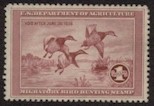
Example of a "Duck Stamp"
Duplex Cancel A two-part post office cancel where the circular date stamp is attached to the killer. Many duplex markings are known with various hybrid CDS and killer types.
Duplicate
An extra copy of a stamp, duplicates may be sold or traded. Before disposing of a duplicate, however, it is always a good idea to check the stamps for varieties or other characteristics that may set it apart. Duplicate also refers to the telegraph stamps affixed to the office of a collect telegram. The collect stamp was affixed to the telegram.
Earliest Known Use (EKU)
During the years before specific first-day dates were assigned to new issues, stamps were distributed to postmasters who placed them on sale as they needed them. In some cases, such stamps were used within days after they were received. Because there is no first day of issue for these stamps, students of postal history rely on the earliest-known (or earliest recorded) use. Such uses must be properly canceled and tied (if on cover) so they can be verified. Although EDUs are quite valuable (they are often unique), they are also quite transient. Dates are constantly being pushed back further with new discoveries. Modern major varieties of stamps (and individual plate numbers, for specialists) also aren't always assigned first-day dates. In such instances, collectors are once again forced to seek out the earliest recorded uses of these issues.
Electric Eye Bars
Bars printed on the margins of press sheets to guide them into position for perforating by means of an electric eye device that positions the stamps correctly. These markings are normally trimmed off of finished coil and booklet stamps, but appear in the margins of sheet stamps. The markings appear to be heavy vertical dashes or horizontal lines at regular intervals.
Electrotype
A method whereby replicas of dies are created for producing more stamp printing plates. Electrotypes are created by applying a coating of copper to a mold (usually wax) from the original die. The process is now obsolete for most applications.
Elusive
A term applied frequently to stamps that may not be rare, but are nonetheless difficult to find. The term also applies to common items that are hard to find in a specific condition.
Embedded-Taggant Paper
A form of stamp printing paper with phosphorescent tagging applied before stamps are printed on it. However, the application of the taggant on this type of paper is much like staining a surface; it soaks into the paper and becomes a part of it, appearing throughout the various layers of paper fibers. Like surface-tagged paper, the printed stamp image appears over the taggant, rather than under.
Embossed
Stamps or stamped envelopes in which all or part of the design is raised above the surface of the paper by pressing the paper between two dies that have patterns in relief. Embossing may be combined with printing or left plain (blind embossing). In U.S. collections, embossing is most commonly encountered on stamped envelopes.
Embossed Revenue-Stamped Paper
Exists primarily from the Colonial days of the United States when documents were embossed to show payment of various taxes. Most revenue items of this sort are colorless and are of far higher value when found on complete documents. If they are cut to shape or on partial documents, they are worth much less.
Encased Stamps
Term applied to postage stamps that have been enclosed in some form of casing (usually metal and mica) for use as emergency coinage. Although several countries have produced encased postage, the most well known are those examples produced during the U.S. Civil War to help alleviate coin and currency shortages. Most encased postage is privately produced.
Engine Turning
Also called "lathework," this produces fine, intricate geometric engravings typically used on early stamps. The delicate, lace-like effect is achieved by use of a geometric lathe.
Engraving
See Intaglio.
Entire
This refers to any form of mint or used postal stationery ( envelope, wrapper or card) left fully intact, rather than cut down to its printed stamp.
Error
Although frequently misused, the term in its philatelic usage has two specific meanings. The first refers to stamps that have one of more inadvertent complete and consistent production error; that is, an inadvertently missing or botched printing or production step, which includes color omissions, imperforates, inverts, double printings, among others. To be a true error, a complete production step must be missing or botched. As an example, a color-omitted error must have no trace of the missing color remaining or an imperforate error may not have the slightest indentation of a perforation; otherwise such stamps are considered freaks include color shifts, misperfs, and other inconsistent printing or production problems. In general, errors are worth more than freaks. The second definition deals with stamp design, Misspellings, typos and incorrect factual or design information on a stamp give such issues design error status, Most design errors affect the entire press run of certain stamps and usually do not increase a stamp's value.
Essay
A design for a stamp, often a form of trial stamp that did not result in a final issue identical in design or printing. Essays may include original artwork for a stamp design that was later accepted or rejected, pulled proofs of designs that were later rejected, or even printed examples of stamps that were not issued. Although some essays are very rare, or even unique, some are fairly common.
Etiquette
Any of a number of different types of special-service labels applied to letters or parcels. More specifically, however, the term applies to special blue airmail labels adopted by the Universal Postal Union for use on airmail letters. These labels are all of a special shade of blue and are generally inscribed, in two lines, "BY AIR MAIL PAR AVION," (French for "AIR MAIL"). These official etiquettes are to be available from post offices worldwide free of charge for postal patrons. They are another form of collectible and are sought when tied to cover.
Expertization
A process whereby collectors submit their stamps, covers or other philatelic items to recognized experts in the field for their opinions regarding genuineness or condition. Although most dealers and auction houses accept the opinions of these experts, they are only opinions - not a guarantee. Expertising may be done either by a recognized individual or by a committee of experts.
Exploded Booklet
A booklet of stamps that has been taken apart. If mounted in its entirety, an exploded booklet would show all panes, covers and interleaving that originally came in the booklet.
Express Mail
A premium-priced overnight delivery mail service introduced in 1983 by the USPS to compete with private express delivery firms, with stamps to prepay the cost in denominations ranging from $8.75 to $14. Because these stamps have no special inscriptions for this service, and are valid for payment of any other postal service as well, they are technically regarded as U.S. definitives.
Face Value
The monetary denomination printed on a stamp and the price paid by a postal patron at a post office. Face value may be expressed in words, symbols, numbers or abbreviations.
Facer Canceller
A type of machine that, with the use of phosphorescent tagging sensors, turns all envelopes the same direction and cancels the stamps.
Facsimile
Nearly perfect reproductions of genuine postage stamps. Facsimiles may be created with or without the permission of the issuing authority and have been used both for study and for fraudulent purposes. Some facsimiles are clearly marked and help collectors to study and identify scarce stamps. Others are unmarked or faintly marked to aid swindlers in their efforts to pass them off as genuine stamps.
Fake
References to faked stamps often include those stamps that are genuine, but have been altered to resemble a much scarcer variety. Such alterations include removing or adding design elements, trimming or adding perforations, re gumming, altering or adding overprints or surcharges and numerous other repairs or alterations meant to deceive the unwary collector.
False Franking
Franking found on a mail piece from a mass mailing, where the face value of the stamp underpays the actual rate. On false-franked covers, the difference between the face value and the rate is paid directly to the USPS when the item enters the mail stream.
Fancy Cancel
Any obliteration that has been created in a decorative fashion to cancel a stamp. Such cancels, whether applied by hand or machine, are known from most countries and are actively collected as a specialty or, in the case of many pictorial fancy cancels, as an adjunct to topical collections. In the United States, fancy cancels had their heyday during the 19th century. Because the killer portion of the cancel was the only part that was supposed to touch the stamp, killer devices were needed to supplement the town and date stamp portion of the cancel. Postmasters of small post offices, most of whom supplied their own materials, had time on their hands and a shortage of funds. As a result, some began carving cork into handstamp killer devices. Some of these cancels, mostly created during the 1860s and 1870s, were quite ornate, while others were political in nature. By the 1880s, fancy cancels were being phased out by the U.S. Post Office Department. During the 1920s, there was a resurgence of fancy cancels when postmasters at small, usually fourth-class post offices began creating their own fancy cancels for use on registered letters. At that time, postmasters' salaries were based on the amount of business they did. Fancy cancels attracted the needed attention to conduct more business, but this practice was soon hut down by the USPOD. Today, some collectors consider some metal die hub cancels that are pictorial a form of fancy cancel, particularly when they are clearly struck on single stamps. The most famous fancy cancels are from Waterbury, CT. Many of these range in value from hundreds to thousands of dollars. Although not all fancy cancels are rare or valuable, they do command a premium over their normally canceled counterparts, and pictorials are usually worth more than geometric's.
Fantasy
Stamp look-a-likes that are complete fabrications from nonexistent countries or localities. Some fantasies were created to defraud collectors, while others have been created for political purposes. Still other fantasy items are made by collectors for the sheer fun of the process.
Farley's Follies
This is a series of special printings created for collectors during the mid-1930s, named after then-postmaster James A. Farley. A number of stamps of the time were presented in ungummed, imperforate press sheets to friends and dignitaries of Farley and President Franklin D. Roosevelt. When a few of these items began to appear on the market, there arose a general outcry from the hobby. As a result, special printings of the entire 1934 National Parks issue, as well as several others, were printed in imperforate, ungummed form and sold to collectors in press sheet and souvenir sheet form. Although the stamps were valid for postage, their origin was never forgotten and they have always been referred to as Farley's Follies.
Faults
Any condition factors that negatively affect the value of a stamp. Stamp faults include, but are not limited to, poor centering, thins, tears, holes, color alterations, extraneous markings, paper inclusions, heavy cancels, short or pulled perforations, facial scuffs, and other elements that can make a stamp less attractive to collectors.
Fermented Fruit Juice Stamps
A form of tax paid revenue for use with fermented fruit juice products. Many tax paid stamps very specifically state their product or use on the stamps themselves.
FFC
Abbreviation for first-flight cover.
Field Post Office (Fieldpost)
A military post office, often traveling, that is capable of processing and moving the mail in the field. Field Post Offices from many countries denote status in their specialized postal Field Post Office markings.
File Fold
Evidence that a cover has been folded so that it would be filed easily. These folds frequently occur near the center of the cover but can appear anywhere. This detracts from the value of the cover to varying degrees: a fold through the stamp is a major problem, but if the fold is at the bottom of the cover and has been pressed out or not folded heavily, the value is not affected as much.
Fine
A term that relates more to centering than to overall condition. A stamp that has fine centering if off center, but its design clears the perforations on all sides. Imperforate examples will be off center, but will have all design margins intact.
Fine Perforation
A perforation pattern with small holes and teeth that are quite close together.
Firearms Transfer Tax Stamps
Issued to show payment of taxes connected with the transfer of ownership of federally regulated firearms. They are affixed to transfer of title documents. These are among the few types of U.S. revenue stamps still in use. The most recent known type was released in 1995.
First Issues
The first series of U.S. revenue stamps released for use during the Civil War. These revenue stamps represented various taxes created to raise funds for the war effort. Although each denomination comes in various types, such as protest, bank check, or certificate, any type of revenue (except proprietary stamps) could still be used for any revenue after December 25, 1862.
First-day Ceremony Program
Special items created for limited distribution to guests at first-day ceremonies. Such programs not only contain the listing of participants and a program of events for the ceremony, but also examples of the new stamp and first-day cancel tying it to the program. First-day ceremony programs may be officially produced by the U.S. Postal Service or by a sponsoring organization. During the late 1980s, these programs became very popular among collectors, and prices rose. The USPS began selling them by subscription to help alleviate demand. Meanwhile, collectors continued to find ways of inappropriately obtaining more than one at ceremonies for trading or resale, causing the USPS to rethink the entire product. Ceremony programs are still distributed at first-day ceremonies, but frequently at the end of the ceremony, thus defeating their original purpose.
First Day Cover
An envelope bearing a newly released stamp and canceled to reflect the first day of its release. A first-day cover may have special markings, such as "first day of issue" that denotes it as such, or it may look plain to the eye. Early first-day covers usually gear no cachet or illustration, while modern examples frequently have elaborate designs, including hand-drawn or hand-painted. In modern-day use, a first-day cover may or may not have been canceled on the actual date it reflects. Large demand for FDCs has resulted in 30-day grace periods for canceling most covers.
First-Flight Cover
Any item of mail carried on the first scheduled flight of a new service route or carrier. While some early first-flight covers have little to distinguish them from ordinary letter mail, most have special adhesive labels, markings, or cachets that enable them to be identified as such.
Fishing Stamps
State revenue stamps to show prepayment of fees for fishing. Like duck stamps, fishing stamps are intended to be placed on fishing licenses and signed by the sportsman across the face. Depending upon various state regulations, fishing stamps may be all-inclusive or cover only one or two specific types of fish.
FL
Abbreviation for folded letter.
Flag Cancel
A term most frequently applied to flag-shaped metal die hub cancellations that contain a flag design as part of the wavy-line killer, widely used in the United States in the early 20th century.
Flat Plate
A printing plate that is flat. Stamps are printed on a flat bed, sheet by sheet. More modern printing involves the use of rotary presses, which utilize curved plates and continuous rolls, or webs, of paper.
Fleet Post Office
A post office for U.S. Navy ships and bases. Some ships routinely use pictorial cancels; most bear the names of the ships.
Flexography
A form of letterpress (or relief) printing. Flexography utilizes rubber or plastic plates that can be molded around a printing cylinder. Flexographic printing is most commonly used to produce types of stamped envelopes and precancels.
Fluorescence
A photochemical reaction to longwave ultraviolet light that causes stamps, inks, and postal markings to glow brightly. Stamps that are fluorescent will glow under both longwave and shortwave UV light. Unlike phosphorescence, fluorescence glows only during exposure to the light source. The use of a long wave ultraviolet light cannot only aid the collector of tagged stamps, but also is essential to the detection of fakes, forgeries and repaired stamps. This type of light is much like those used in poster shops and roller skating rinks. There is no inherent danger to using longwave UV light.
Flyspeck
Describes any of thousands of types of minor varieties that require magnification to clearly see. These varieties can include plate varieties, printing anomalies, or paper varieties.
Folded Letter
Before envelopes came into use, people folded their letters so that the text would be concealed inside, with a blank side on the outside left to write the address. Envelopes did not come into widespread use until the 1850s.
Foreign
A term used by collectors to describe the stamps of all countries other than their own.
Foreign Transfer
The definition of this plate variety, which is one of the scarcest of all plate variety types, is much the same as that for double transfers. The biggest difference is that the bits of design elements visible on the finished stamp are those of a different stamp design.
A documented historical predecessor of a stamp or series. In some cases, this may refer to stamp series or designs that were forerunners to later issues. In others, the term may refer to geographical or political forerunners to a country's postal administration.
Forgery
A forgery is an unmarked reproduction or fabrication of a real stamp (usually scarce) that is intended to defraud collectors. Numerous common forgeries also exist. These were created to fill large demand for supposedly common stamps for use in packets and mixtures. Most of these were created during the early part of the 20th century. Forgeries can be very realistic or very crude.
Format
Private firms that undertook the dispatch of overseas mail from major cities and commercial centers during the late 18th to the mid-19th centuries. Many of these applied distinctive manuscript or hand-stamped markings to the mail they handled, which was deposited for a fee paid by the sender at the post office of the country of destination with adequate postage to carry it on to its destination.
Foxing
A condition associated with deteriorating paper as a result of age, improper storage, sunlight, or various combinations. Specifically, foxing refers to yellowish-brown spots or stains that appear on aging paper, due to a chemical reaction. In many cases, old covers and stamps have these telltale stains. In recent years, foxing also has been associated with several early attempts at self-adhesive stamps. Because there was no barrier layer to separate the unstable adhesive from the stamp paper, the adhesive used with these stamps eats away at the paper. This is particularly true of the 1974 10-cent United States Dove Weathervane stamp. In some cases, foxing can be reversed to salvage these stamps. Foxing is considered a stamp fault and frequently is caused by various forms of bacteria.
FPO
Abbreviation for Fleet Post Office.
Fractional-Denomination Stamps
Stamps issued in fractional denominations for use by major mass mailers to take advantage of the various automation sorting discounts available to large-volume postal customers and bulk mailers. Virtually all these stamps of the last 25 years have been issued in coil format only, because only coil stamps can be used in the high-speed stamp-affixing equipment that mass mailers use.
Frama
Although the name Frama is specific to a manufacturer of special patterned papers for use in automated vending machines, it is used interchangeably by most collectors for most types of computer-vended variable denomination stamps. Frama labels are a form of stamp that consists of a specially printed patterned background design. The denominations are then placed on these items at the time they are vended by the machine. Thus a single type of Frama may have a nearly unlimited number of different denominations.
Frame
The outer part or border of a printed stamp design. Frames can range in complexity from a simple line to an ornate and elaborately detailed arrangement covering much of the printed stamp.
Franking
The way in which the postage on a given piece of mail is prepaid.
Freak
A highly collectible form of printing or production problem. In many cases, freaks look more spectacular than major errors, but are generally more affordable. Freaks include misperforated or miscut stamps, color shifts or smears, nearly missing colors or perforations, set-offs and a host of other odd-looking items. A freak is differentiated from an error because it is a more random occurrence. A freak may be unique or may occur inconsistently on numerous stamps, but is not a major error of the printing or production process.
Free Franking
A printed or hand-written notation that mail should be sent through the mail stream free of charge. In the United States, this is a privilege extended to military personnel during wartime, to federal elected representatives during their terms of office, and to presidents for the rest of their lives.
Front
A cover that has had the back side removed. Removal of a cover's back may include removal of a damaged area, making the item easier to mount, or simply ignorance of philatelic practices. While a front is definitely worth more than a piece in most cases, it certainly is worth far less than a complete cover.
Fugitive Ink
Water-soluble ink, which was used to discourage fakes, forgeries, and the chemical cleaning of stamps for illegal reuse. Such inks run when moistened and are easily damaged by rubbing. Such stamps are left on the piece when collected as used examples.
Future Delivery Stamps
Created to facilitate tax collection on any sale of crops, goods, or merchandise at boards of trade for contracts related to the future delivery of any of those by-products.
General Issues
Postage stamps released for general use, which include definitives and commemoratives.
Generalist
One who collects the stamps of many different countries, or a collector who does not have a particular specialist.
Germania
A specific series of stamps and postal stationery released between 1900-21 by Germany. The woman's figure, based on opera singer Anna von Stratz-Fuhring, was created by Paul Waldraff, and is supposed to represent the German Empire.
Glassine
A special, resilient, glazed paper that is nearly transparent. The glazing prevents easy passage of air, grease, and moisture. As a result, this has been the paper of choice for special envelopes used to store and protect postage stamps. These envelopes are referred to as glassine's by collectors. Glassine paper should not be confused with waxed paper, which can harm stamps. Glassine also is the paper used to manufacture stamp hinges.
Goat's Eye
Popular nickname for the second general issue of Brazil, from 1844-66. These stamps resemble the much scarcer Bull's-Eye issues of 1843, but are smaller.
Goldbeaters' Skin
A thin, tough, nearly transparent form of paper. For those issues that have been printed on goldbeater's paper, such as U.S. essays and 1886 stamps of Prussia, the stamp is printed prior to gumming on the inside of the paper, with the adhesive applied over the top of the ink, as a security feature.
Granite Paper
Granite paper is a form of paper that contains numerous colored fibers. In most cases, granite paper has been produced as a form of security device to deter postal counterfeits.
Graphite Lines
During the late 1950's, Great Britain began experimenting with marking stamps to expedite mail handling. One such experiment involved the placement of backs of stamps, which could be sensed by automated equipment. Although the practice was discontinued after a relatively short time, a number of British Wilding series stamps are known with these experimental, and collectible, lines.
Gravure
Grill
A network of lines, waffle patterns, or other forms that are embossed into the stamp paper after printing. As a security device, a grill's purpose is to break the paper fibers so that the paper readily absorbs the cancellation ink. This is intended to preclude the removal of cancellations for illegal reuse of previously used stamps. The embossing is done with a metal roll with tiny points. If applied from the back, the grill is said to be "points up," because they show from the front, and if the grill is applied from the front, it is said to be "points down," because they appear on the back. Grills, used on numerous 19th century U.S. stamps from 1867-71, are no longer in use.
Gripper Crack
A form of plate variety that occurs along the top or bottom row of stamp subjects on a printing plate. Tension cracks occur on printing plates most frequently where the grippers hold the curved plate to the cylinder. These cracks collect ink and deposit it on the printed stamps. Gripper cracks look just like a crack, jagged line, or series of lines running through the stamp design.
Groundwork
The background of a stamp upon which the primary stamp subject is shown. Groundwork may consist of solid or muted colors, designs, or other graphics.
Guide Dots or Lines
When a printing plate is created, markings to aid perforating and trimming are added. In most cases, these markings are trimmed off, but some finished stamps show these lines and dots. U.S. sheet stamps of the early 20th century frequently feature guide lines and arrows extending through the pane. These markings are usually collected in blocks.
Guillotine Perforator
A single-row stroke perforator that received its name from the execution tool of the same name. The term describes the action of the perforator, which perforates in only one direction. Guillotine perforators are commonly used to perforate webs of coil stamps before they are slit into individual rows that form coils.
Gum
The adhesive found on most stamps. The term is derived from gum arabic, an early type of adhesive.
Gum Breakers
Ridges or impressions that appear across the back of sheets or panes of stamps. They are created by special rollers that impress the stamp paper. The intention of the gum breakers was to break the pattern of the gum so that finished sheets and panes of stamps won't curl so severely in changing humidity conditions.
Gutter
The space left between panes on a printing sheet to provide the margin for cutting panes without damaging stamps. Gutters may be intentionally left, such as those found on press sheets, or they may occur in error as a result of a miscut.
Gutter Snipe
A freak created by improper trimming of sheets into post office panes, referring to any internal marginal selvage that is trimmed in a manner so that it is perforated on all sides. Gutter snipes are fairly inexpensive, but a pair of stamps with an unintentional full gutter between them is worth considerably more.
In photogravure, offset, or letterpress printing, a halftone screen is formed when the image is broken down into small dots in varying concentrations, allowing the eye to see all tonal gradations between black and white.
Hammarskjold Invert
In 1962, the United States released a commemorative shortly after the untimely death of United Nations Secretary General Dag Hammarskjold. Within a few days of release, collectors began finding a few panes of stamps with the yellow color inverted in relation to the rest of the design. The U.S. Post Office Department immediately sent the stamp back to press and intentionally printed millions of error stamps in an attempt to destroy the value of the originals, angering thousands of collectors and setting the stage for a landmark court battle preventing the post office from intentionally creating special printings of stamps to destroy collector value.
Hand Drawn
Cachets (usually on first-day covers) that have been completely drawn by hand. Such covers may either be black and white or painted.
Hand Painted
Although similar to hand drawn, hand painted also includes those cachets that have been reproduced by mechanical means (printing or photocopying) and then painted to provide color. Generally, such covers are worth less than hand drawn and painted covers, but more than mass-produced printed covers.
Hand Stamp
Application on a cover, usually with inked rubber stamp of such postal markings as postmarks, registry, and other special-service markings or auxiliary marking phrases, like "Held For Postage," "Advertised," and "Not Called For." Hand stamp can apply to any marking that is hand-stamped on a cover, but generally refers specifically to markings applied by an inked steel or rubberstamp device by hand. The term also refers to the device itself. The process of perforation that applies perforations to an entire printing sheet of stamps at once in a single stroke. Because of the nature of this type of perforation, virtually any shape of perforation can be created, ranging from round to elliptical, square, diamond, star, and many others. Harrow perforations are usually crisp and clean, with no distortion of shape.
Head Plate
Heliogravure
An early form of the photogravure process for printing stamps.
Herringbone Cancellation
A form of cancellation that disfigures the stamp. A cut (sometimes inked), in the regular repeating pattern of a herringbone, not only ties the stamp to the document, but also effectively prevents illegal reuse of the revenue stamp involved. Because of the damage to the stamp, herringbone cancels generally make a stamp worth considerably less than inked cancels.
Hi-Brite
A collector term given to papers that contain optical brighteners or other fluorescent material that make a stamp glow brightly under longwave ultraviolet light. Hi-Brite effects on stamps are unintentional.
Hinge
Perhaps the most basic and enduring form of stamp supply available. A stamp hinge is a small, gummed piece of glassine (folded or unfolded) used to mount stamps on album pages. The gummed side of the hinge is lightly moistened and placed on the back of a stamp, folded down and placed on an album page. When properly used, a hinge will allow the viewing of a stamp's back side by merely lifting it slightly from the page. The best type of stamp hinge is one that is fully peelable; that is, it does not ruin a stamp when removed. Stamp hinges are now used primarily for canceled stamps, so that the gum of mint stamps is not affected.
Hologram
A stamp or stamp item that features a form of specially treated thin foil that appears three-dimensional to the viewer. This illusion is created by recording, on a photosensitive surface, the pattern of interference formed by a split laser beam. The pattern can be illuminated by either natural or artificial light, giving the illusion of a 3-D image. A hologram, a 3-D stamp, has a slightly silvery appearance to it, with some perceived color visible. Stamp items that include holographic images first began in the late 1980s. Small pieces of holographic plasticized foil are applied to the stamp paper, or are windowed into stamp envelopes. As with any new technology, holography on stamps gave birth to a new major error: missing holograms. Holograms printed on silver foil have been used as part of the stamped design on U.S. stamped envelopes released in 1989, 1990, 1992, and, for the first time on postage stamps, in the year 2000.
Holograph
Any document (such as a letter) that is written entirely by the person whose signature it bears.
Horizontal Pair, Imperforate Vertically
A horizontal pair of stamps lacking vertical perforations between stamps and with vertical straight edges at either side. Perforations are present at top and bottom. Such items should not be confused with imperforate between, which refers to a pair with perforations on all sides, but not between stamps.
Hotel Stamp
A form of an adhesive (sometimes hand-stamped marking) used to show the prepayment of postage from a hotel to the nearest post office. Hotel stamps were most commonly used throughout parts of Europe during the latter part of the 19th century. The fee collected by hotels for this service was above the postage required for governmental delivery to the recipient. Hotel stamps, and covers bearing them, are prized by collectors.
HS
Humidor (or Sweat Box)
A device used to remove stamps from paper (or those stuck together) without seriously disturbing the gum. Affected stamps are placed on a shelf or platform above water, and then are sealed in a container. The resulting humidity eventually loosens the stamp for removal. This technique also is preferred for removing stamps with fugitive inks from paper.
Hunting Permit Stamp
Hydrogen Peroxide
A cleaning chemical used by collectors to counteract the effects of oxidation on stamps printed with ink containing iron. Hydrogen peroxide also can be used to clean slightly yellowed paper. In both cases, this type of cleaning is acceptable, because it does not damage or alter a stamp in any negative way; however, peroxide should be used only on stamps with no gum, because it will remove the gum from mint stamps.
Hyphen-Hole Perfs
Dash-like perforations where tiny rectangular holes are punched in the paper, rather than the more standard round holes. Because of the nature of their appearance, scarcer hyphen-hole perforations frequently are confused with roulettes.
I
Any intentional or unintentional unauthorized, inappropriate, or other use of a stamp for any purpose for which it was not intended. Examples of illegal uses include stamps that have been demonetized, revenue stamps used as postage, postal stationery stamps (the printed stamps on stamped envelopes and postal cards) cut out and glued to envelopes, reuse of previously used stamps, taped stamps, non-postal labels used as stamps, and short-paid mail. To postal history collectors, the most desirable illegal uses are those that were detected and either assessed postage due or returned to sender with explanatory auxiliary markings applied. Non-stamps, such as Christmas or Wildlife seals used as postage, also fall into the illegal use category. Postally used covers showing such illegal uses are generally prized by specialists.
Imperf Between Stamps
Stamps generally considered pairs or larger multiples of stamps with no perforations in one direction, but with perforations on all other sides. Pairs or multiples may be either horizontal or vertical; thus, a horizontal pair of stamps may be missing vertical perforations (vertically imperf between) or a vertical pair may be missing horizontal perforations (horizontal imperf between). It also is possible for a single row of perforations to be missing from a pane, leaving, for example, an imperf-between multiple of three or larger with perforations around. Imperf-between stamps are regarded as major errors and frequently command premium prices.
Imperforate
Refers to any postage or revenue stamp that occurs with no perforations. These are most commonly found in the first-issue series of revenues. When used to describe a pair or multiple, imperforate means completely lacking perforations between stamps and on all sides. Stamps lacking die cuts may also be referred to as "die cut omitted." Imperforates may be intentional, such as the Penny Black or the first revenue issues of the United States, or they may be major errors. Although imperforates are collected as singles, pairs and larger multiples serve as absolute proof that perforations were not trimmed from normal stamps to make them more valuable.
Imperforate Coils
Stamps in a coil formed without perforations, intentionally or unintentionally. Early in the 20th century, imperforate coils were created by the U.S. Post Office Department for the use of private companies that perforated the coils to meet the requirements of their own equipment. Some types of affixing equipment didn't require specific types of perforations, and imperf coils were used as is. Thus, it is possible to find coil strips of intentional imperforate coils, as well as uses on cover. Unintentional imperf coils are major errors where perforations have been omitted. Some imperf coil errors are quite inexpensive, while others sell for thousands of dollars.
Imperforate Margins
Occasionally, stamps occur with perforations omitted between the design and the margin. They should not be confused with stamps issued with natural straight edges.
Impression
An imprint of a stamp or stamps, taken from a die, plate, or other printing base.
Imprint Block
A multiple of stamps, usually four or more, with a printed selvage attached. This printed information may include printers' initials, plate information, slogans, illustrations, or other forms of data. Like plate blocks, imprint blocks are considered premium position pieces, but they generally are less in demand.
Inconstant
A variety that occurs at random, such as an inking or printing flaw. Such varieties, even when similar in appearance, are never alike.
India Paper
A form of paper frequently used for pulling die proofs. India paper is a thin, tough, translucent paper that is highly flexible and able to print very fine details. Although India paper is now classified more by texture and characteristics, true India paper was made from bamboo fibers.
Indirect Printing
Any form of printing where the printing plate does not come in direct contact with the substrate, or paper.
Inflation Issue
Stamps released by different countries during periods of high financial instability to pay swiftly rising postal rates. Many inflation stamps bear very high denominations and were in use for only short periods of time. Others are normal stamps with surcharges applied to reflect the higher denominations needed.
Inking Flaw
One of many different types of freak varieties that can occur on stamps. Printed by any technique. An inking flaw may range from a small blob of extraneous ink to huge smears or uninked areas. After a line-engraved printing plate has been inked, it is wiped clean, removing all ink that is not in the recessed lines of the plate. Sometimes, either through improper inking or overzealous wiping, too little ink remains in the printing plate to produce a suitable printed image. Such varieties, which are very desirable to collectors, are considered to be defective stamps by the printers and are usually removed and destroyed prior to distribution. As a result, these varieties have additional value to collectors, the value being determined by how significantly the flaw affects the appearance.
Ink-jet Cancel
A recent form of postal marking that is applied by an ink-jet printer. The markings can be informational, slogan, straight line, or many other types. Although used by some countries to cancel stamps, U.S. ink-jet markings are intended to correct stale meter dates or record specific mail processing information.
Ink-jet Markings
Postal markings introduced in the late 1980s to date the receipt of metered mail by the Postal Service and now used much more widely to code commercial mail for delivery. Ink-jet dated markings or cancellations applied across the top of an envelope typically encode the date, post office name, state, and ZIP code, and may contain slogans as well. Ink-jet sorting marks across the bottom of an envelope encode the ZIP code in machine-readable form to speed up mail sorting at large mail-handling facilities.
Inscription
The integral design elements on a stamp that include the lettering and wording. An inscription may also refer to wording, lettering, or markings that appear in the marginal paper on a pane.
Inscription Block
A block of four or more stamps, with the selvage attached, that bears an inscription. Some types of inscription blocks sell for premiums over their normal counterparts.
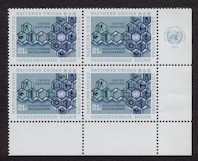
Example of an "Inscription Block"
A form of mail service, available for a fee, which indemnifies the contents against theft or damage. Frequently, covers bearing insured markings and the appropriate postage are prized by postal history collectors.
Intaglio
The most commonly used form of printing on early stamps and also the most secure. Also known as recess printing, engraved, and line-engraving, intaglio is a form of recess printing; that is, the design is etched into the printing plate, below the surface. When the original design is engraved in reverse into the die, the image is reproduced in relief on the transfer roll. The transfer roll then is used to rock the design in reverse into softened steel plates, which are hardened upon completion of the process. When printing begins, ink is applied to the plate and the surface is wiped clean, leaving ink only in the incised lines. When the moistened paper is applied to the inked plate under pressure, it picks up the ink from the grooves, leaving the final printed (and slightly raised) image.
Interleaves
The translucent sheets of glassine paper spaced between pages in a stamp booklet or album to prevent stamp abrasion and adhesion. Although interleaving is desirable in most albums, it is necessary for those with printing on both sides of each page.
Interrupted Mail
Any form of mail that was not delivered as planned, due to war, disease, famine, or mishap. The most common use of the term deals with mail that has been salvaged from wrecked vehicles.
Interrupted Perforations
Although the term is fairly synonymous with syncopated perforations, interrupted perforations are slightly different. To provide additional strength, interrupted perforations are missing selected perforation holes, leaving a larger-sized bridge than normal. U.S. privately perforated stamps of the Washington-Franklin series featured interrupted perforations.
Interverted
This arcane term describes either a pair of stamps or a stamp with attached label or counterfoil that has been either printed, cut, or separated in the improper sequence.
Invalidated
A postage stamp no longer valid for postage. During the Civil War, all U.S. stamp issues prior to 1861 were invalidated to prevent Confederate resale or use.
Invert
Describes any one of a number of bi-colored stamps from all over the world with the center vignette upside down in relation to the frame. Early bi-colored stamps required two passes through the printing press, making such errors possible if a printing sheet was picked up after the first color was printed, examined, and laid back down improperly. Technically, the frame is usually inverted, because the vignette is printed first, but such stamps are more striking when shown with the vignette upside-down. Inversions also occur with watermarks, perforation patterns, and other stamp elements.
Irregular Perforations
Perforations on any stamp where the holes aren't evenly aligned, are different gauges or sizes, are misplaced, or are in any way abnormal.
Issue
The process of releasing a stamp. The term also applies to the actual released stamp.
Ivory Head
A characteristic of the paper of many early stamps of Great Britain, which were bluish-tinged. Such stamps were printed by Perkins Bacon. When soaked, the reverse side of the stamp frequently showed an ivory-colored cameo-like portrait of Queen Victoria, surrounded by the characteristic bluish tinge. There are several possible causes, but most likely the effect has to do with a chemical interaction between the printing ink and the paper.
Joint line (or Join Line)
This is the point at which two curved printing plates are joined to create a single printing cylinder. ON intaglio stamps, this is the point where ink collects in the seam and prints out on the stamps. Joint lines are found on only older rotary press stamps (mid 1980s and before.) Newer presses create continuous sleeves without lines. Joint lines are collected primarily as line pairs or strips of four with the line centered.
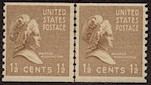
Example of a "Joint Line" pair
A form of postage stamp used to pay the bulk fees (and sometimes taxes) on mailings of newspapers, magazines, and other periodicals.
Jubilee
A jubilee (typically a British term) marks a 25th (silver), 50th (gold), or 75th (diamond) anniversary of a ruler's reign, a royal wedding, or of a country's independence. In many cases, a stamp or set of stamps is released to mark the event, called Jubilee issues. Some Jubilee issues are released as parts of larger, multiple-country sets called omnibus issues.
Key Plate
One of two parts of special bicolored stamp designs produced for multiple uses. These design elements include the key plate and the duty plate. Many postal entities, such as various French Colonies, use the same stamp designs for different colonies. Others, such as the United States bicolored postage due series of 1959, use the same basic design, with changing denominations. The key plate is the basic stamp design or background patter with unchanging design elements. The duty plate prints the changing part, such as the denomination or country name.
Keytype
An identical stamp design used by several different colonies or entities. Generally, the key plate provides the basic design, while the duty plate provides the country or entity name. Keytype stamps are also created by overprinting printed stamps with the country or colony name.
Killer
The portion of a cancel that defaces the stamp and makes it invalid for postage. For most of the stamp period in the United States, it was forbidden to cancel a stamp with the CDS alone. The vast majority of fancy cancels were the killer portions of cancellation devices.
Kiloware
Any form of mixture on paper that is sold to dealers or collectors by the kilogram (about 2? lbs). Such mixtures may be hospital, mission, charity, post office, parcel card, or any other form of mixture. Essentially, kiloware represents on-paper stamps torn from card or cover, sold by weight.
L perforator
Perforating equipment that perforates in only one direction at a time. L perforators are so named because they are shaped like an "L."
Label
Adhesive or self-adhesive paper attached to mail to fulfill a special purpose (for example, a customs form) or to indicate special treatment or provision of special postal service (as in the case of an airmail label).
Lacquer Bars
A form of early security device used primarily by Austria. Diagonal lines or bars of lacquer were applied to sheets of stamps (on the face side) to make it difficult to fraudulently remove postal cancellations for illegal reuse. Varieties of these bars exist.
Laid Paper
One of several different types of paper used to print stamps. Unlike wove paper, laid paper is characterized by closely spaced parallel lines running through the paper. These lines are created during the papermaking process. These lines may run vertically or horizontally, depending upon how the paper traveled through the press.
Last-Day Cancellation
A postmark from a post office dated the last day the office is in operation. IN 1997-98, the term was also used by the USPS to describe special cancellations it applied to stamps on the final day they were available from the post office.
Late Fee Stamps
A special class of stamp used by some countries to pay the additional postage necessary when items are mailed after normal postal hours.
Lettersheet
A piece of paper with a stamp already printed on it so the user can simply fold the letter and send it on its way. Most countries that have a postal stationery have released at least one lettersheet. The most well-known of these is the first: the British Mulready of 1840.
Line Pair (Joint Line Pairs)
Any pair of stamps with a printed line of ink between them. Such stamps were long saved as pairs to preserve and display the line. Lines appear for two main reasons. One is as a cutting guide, intended more for sheet stamps than coils. The second deals with printing technology. When rotary presses were first used in printing stamps, two flat printing plates had to be curved to form a single printing cylinder. The space where the plates met gathered ink, which was then transferred to the printed stamps. Thus the stamps on either side of the line are created from different plates. Line pairs are considered premium positions, as plate blocks are for sheet stamps. With the end of the use of Cottrell presses in the 1980's, coil lines on U.S. stamps came to an end.
Line Perforations
Line perforations are produced by rotary perforating wheels that perforate in only one direction at a time. The perforations created by these wheels leave ragged intersections where perforations meet in blocks.
Lithography
A form of direct surface printing that works on the principal that oil and water do not mix. The traditional lithographic plate is a litho stone (a form of limestone from Germany). The design is drawn in reverse with a form of grease pencil. The stone is then moistened and inked while wet. The printing ink, which contains oils, is attracted to the grease-penciled area and repelled form the wet, blank stone. The inked design is then transferred to the paper.
Local Post
This term has two meanings. First, it refers to any privately operated postal service that works independently of the government-authorized mail service. During the 19th century, many different local posts were in business in the United States, and many had their own stamps. These were closed down by the federal Private Express Statutes, which gave the monopoly on handing letter mail to the U.S. Post Office Department. The term also refers to modern-day local posts, which do not typically carry mail (other than in a souvenir capacity), but issue stamp-like labels or markings for collectors.
Local Precancel
A stamp that has had its precancel marking applied by a local post office. The printing quality of the cancels on these stamps (often applied by hand) is usually not as clear or as distinct as on bureau precancels.
Local Revenue Stamps
Revenues issued at the county, city, or municipal level. These stamps may be used in conjunction with federal and/or state revenues or may be used alone.
Local Stamps
Frequently confused with carriers' stamps, local stamps were privately produced stamps to pay for private postal service fees that either supplemented or competed with official postal service. Such stamps, called locals because of their limited range of validity, were released by numerous companies in the United States and other countries. Each was valid only within a limited district, route, or city. With the establishment of the Private Express Statutes of 1861, local posts in the United States were abolished, as was any service that directly competed with the post office. U.S. locals, including those produced for the Pony Express, flourished from 1844-45 (when they were technically outlawed), on a limited basis from 1845-61. Only two, Boyd's and Hussey's, continued about 20 years after that point.
Lock Seals
Stamp-like items that were inserted in what was called seal locks to prevent tampering. This helped the Internal Revenue Service ensure that taxes were paid by distilleries for all that was owed. When a key was inserted into a lock, it would first punch through the lock seal. If done under proper supervision, this was normal. If, however, a tax agent found the broken seal in a lock, he knew that tampering had taken place.
Loose Letter
Although mail pieces are now seldom found with this marking, a loose letter is one that arrives at the destination post office with no cancel or mark of origin. Most loose letters years ago were received form incoming ship. Modern-day loose letters are called skips.
Luminescence
A catchall term that refers to all stamps and markings that glow. Luminescence encompasses both long-wave and short-wave ultraviolet light characteristics, as well as phosphorescence and fluorescence.
Machine Cancel
A cancellation imprint imparted to a cover by a machine, not a hand stamp. Most machine cancellations are metal die hub cancels.
Magnifier
An essential piece of stamp collecting paraphernalia, a magnifier allows a collector to see details of a stamp not easily seen with the naked eye, including plate flaws, design details, some repairs, and other more or less hidden flaws. A 10-power magnifier is adequate for most collectors' needs.
Mail-Bid Sale
A private sale in which there are no bidders present. A catalog describing all stamps is prepared in advance and distributed to collectors, but all bidding is done by phone, Internet, or mail. The winning bids are determined by a pre-set cutoff date and time, when all bids are tabulated. In recent years, mail-bid sales have become at least as popular as public auctions for the buying and selling of stamps.
Mailer's Permit Postmark
A private cancellation approved by the Postal Service that enables holders of a Mailer's Postmark Permit to cancel and use precancels and other fractionally denominated or non denominated service inscribed U.S. stamps.
A system in the United States that permits mailers to create and use their own postmarks. This service requires a special permit that is available at no cost from the U.S. Postal Service. Although mailer's postmarks are intended primarily to save time for bulk mailers, some are utilized by stamp collectors and dealers. As used by bulk mailers, mailer's postmarks are usually applied by a printer to precanceled bulk-rate stamps. This gives the appearance of a standard mail piece to solicit a better response for the mailer. As used by collectors, mailer's postmarks allow for cleaner cancels than are applied by many machines.
Major Varieties
Stamps that differ significantly from the originally released versions. A major variety can be a different printing, a printing variety, or even a form of error. Generally, if a stamp variety can easily and consistently be distinguished on a mint or used single stamp, it may well be a major variety.
Make-up Rate Stamps
Non denominated stamps issued for use with stocks of previously issued first-class letter rate stamps in making up the difference between the rate, shown and a newly introduced rate. The first U.S. makeup-rate stamps were the (4-cent) bister and carmine test-only stamp, used during the rate increase from 25 cents to 29 cents in 1991.
Manuscript Cancel
Many early postmasters (or postmasters of very small offices) used pen cancellations because they did not have hand stamps. Many of these early markings are very rare. Later manuscript cancels on stamps are less valued than standard markings. By the end of the 19th century, manuscript cancels were uncommon but still considered less desirable than inked cancels. Manuscript cancels (More likely obliterations) are fairly common today but are used primarily for revenue protection when un canceled stamps are discovered. Such modern-day pen cancels are considered a fault.
Map Stamps
In 1919-21, Latvia used the reverse sides of old, unfinished maps and currency to print its stamps. Thus, the back sides of these stamps show partial map designs.
Margin Copy
Any stamp identifiable as coming from the edge of a sheet or pane and showing evidence of the sheet margin or selvage. Such stamps come from one of the top, bottom, or side margins of a stamp pane. As such, the stamp may have attached selvage or a naturally occurring straight edge. In the case of an imperforate stamp, white stamp paper extending from one side shows the margin, with no trace of an adjoining stamp on the affected side. Because selvage is easily trimmed, the blank margin may be extremely wide or quite narrow. There are large- or small-margin copies, depending upon the stamp's location in a pane or how much the selvage has been trimmed.
Marijuana Stamps
Issued by various states to aid in the war against drugs, these stamps, in theory, represent the payment of taxes on marijuana. In most cases, drug dealers are supposed to buy the stamps (frequently with high face values) to show that taxes have been paid. Of course, it is highly unlikely a dealer in illegal drugs will make such a purchase and document his activities. IF a dealer is nabbed and does not have the documentation of marijuana stamps, he also may be charged with tax evasion, which may yield a harder sentence.
Maritime Mail
Any form of seaborne mail, much of which bears a special postmark to that effect; however, maritime mail in its true form was introduced in 1939 by the Royal Navy. The marking "Maritime Mail" was used as a security device to avoid using the ship name, port of landing, or date.
Married Pairs
Some of the printing plates used to produce Penny Blacks of 1840 also were used to produce Penny Reds. As a result, all printing characteristics (and flaws, if any) are identical. A married pair is a Penny Black and Penny Red, from the same printing plate, and with the same check letters to denote the same position on the plate.
Master Die
The original engraved die from which all transfer rolls and printing plates are created. A flaw on a master die will show on every stamp printed.
Master Plate
A printing plate saved so that other plates may be created from it, if necessary. In a sense, a master plate may be used similar to a die.
Mat
A rubber letterpress printing plate (usually hardened), which is used to apply precancels, surcharges or other overprints on stamps.
Mat Variety
The printed evidence of damage to an overprinting mat. Such varieties are very similar in nature to a plate variety.
Match and Medicine Stamps
See Private Die Proprietary Stamps.
Matrix
Any form of intermediate die or mold used to duplicate an original die. This practice is necessary when working with old dies that have become brittle or fragile with age.
Maximum Card
Although the definition of what constitutes a maximum card has loosened somewhat over the past few years, the general idea is the same: it is a picture postcard or other similar item that not only bears a depiction that matches a stamp design, but also has the stamp affixed, with a related cancel. Traditionally, the illustration should have existed prior to the stamp. More recent maximum cards have been created specifically for collectors, with the cards being produced about the same time as the related stamp.
Meter Impressions
The printed impressions left by postage meters to show prepayment of all classes of mail. Meters were introduced in 1903 and have gained such wide-spread use that few businesses still use postage stamps. Meter impressions are quite collectible, particularly the oldest examples. Many others, with pictorial imprints, are collected topically. A meter impression may be found printed either directly on the envelope or on gummed labels.
Microperfs
Similar to fine perforations, except even smaller. Microperforations frequently contain hundreds of perforation holes per inch.
Microprinting
A form of printing (usually offset lithography or line engraving) made up of tiny letters and numerals, either as text or used to form larger patterns or design elements. Most forms of microprinting are nearly invisible to the naked eye, often appearing as nothing more than a broken line in the design. Although there are many applications for microprinting, it is most commonly used as a security device for printing different types of stamps, banknotes, and other securities. Canada has used microprinting for years to identify the year dates of various stamps. The United States began using microprinting in the 1990s, both as a security device and as a design element. Other countries have begun using it as the technology has become available.
Military Stamps
Such items are created and issued for use by a country's military, usually during times of war.
Millimeter
Unit of measurement in the metric system. There are 1,000 millimeters in a meter, or 10mm in a centimeter (25.4 to the inch). In addition to design measurements, cancellation diameters frequently are expressed in millimeters.
Miniature Sheet
A small sheet of stamps. In many cases a miniature sheet may also be a souvenir sheet (but not always).
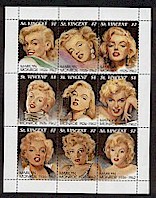
Example of a "Miniature Sheet"
Minor varieties differ from an original version of a stamp, but are not as easily distinguished as major varieties. Minor varieties may include gum types, shades of color, perforation differences, plate varieties, paper types, and numerous others.
Mint
Stamps in post office condition. A mint stamp has full, original gum that has never been hinged. It also is fresh appearing. In addition, mint stamps are assumed to be free of all defects, such as soiling, creases, stains, tears, or other markings or faults. Mint is different from unused.
Mirror Print
A form of freak where all or part of a stamp design is reversed on the gum side.
Miscut
A fairly common form of freak that is a result of stamps being poorly trimmed. Miscuts can occur on stamps at any format, in any degree from minor to major. The greater the miscut, the more desirable the variety. Miscuts can include portions of other stamps, marginal markings, plate numbers, or other information that would appear on the uncut printing sheet. A single miscut stamp can be larger or smaller than its normal counterpart.
Misperforation
A misalignment of a stamp's perforations with respect to the intended design of the stamp. Misperfs, considered freaks rather than errors, are some of the most visually attractive and sought-after EFO items. Misperfs can include vertical or horizontal misalignments (or both), and diagonal misperforations is the type that deals with jumbo or boardwalk-margin stamps. These stamps, which frequently sell for many times the standard catalog value, appear normal but have huge margins. They frequently sell for multiples of the value of a normal copy of the same stamp.
Mission Mix
On-paper mixture containing stamps gathered for mission work or other charities. Such mixtures are supposed to be rich in foreign stamps and often contain the unexpected. In recent years, the term has come to mean almost any form of bulk mixture.
Missionaries
A name given by collectors to the early typeset issues of Hawaii. The name was applied to the rare stamps because most surviving copies have been found on letters sent by Hawaiian missionaries to friends and relatives at home.
Mixed Franking
Describes any cover bearing the stamps of more than one country. Mixed franking's can occur for any number of different reasons. The earliest mixed-franking covers occurred when letters and other postal matter traveled between more than one non-Universal Postal Union country. Because no reciprocal payment agreements existed, payment for postage was necessary in each country, expressed in the stamp of the sending and receiving nation. More recently, mixed-franking covers occur either when a cover must be rerouted (and a postal clerk deems the need for additional postage), or when an inbound cover has insufficient postage affixed and is assessed postage due. Thus, a cover bearing the postage stamps of one country and postage due stamps of another comprise one form of mixed-franking cover; this is probably the most common mixed franking. The more countries' stamps that appear on a single cover, the scarcer it is, except for special around-the-world covers created as souvenirs by collectors. Mixed franking's also are known as combination covers.
Mixed Perforations
A very scarce type of perforation that is formed when a sheet of stamps is perforated (perhaps poorly), backed with a gummed strip of paper and then perforated again, by a perforating device, leaving holes that are different from the originals. Several examples of 1901 stamps from New Zealand are known with these mixed perforations.
Mixture
A group of stamps, usually unsorted, that generally contains a large number of duplicates and frequently bits of paper from the envelopes from which they were taken. Most mixtures are sold by the pound. Historically, the most popular form of mixture has been the mission mix.
Modeler
In the printing process, the modeler is the individual responsible for taking a drawn, painted, photographic, or computer image and translating it into a form that can most easily be adapted to one of the primary printing processes.
Monochrome
A stamp consisting of only one ink color.
Motor Vehicle Use Stamps
Generally, these were affixed to the inside windshield of automobiles to show payment of fees for a specific period of use.
Mounting
The act of carefully placing stamps on album pages for exhibition or personal display. It is vital that stamps are properly and carefully mounted to avoid any form of damage.
Mourning Stamps
Stamp issues released in tribute to a recently deceased person, often a monarch or leader. Numerous countries over the years have released mourning stamps of different types. The most recognizable of these are those that are either edged or printed in black, such as the illustrated 1935 Queen Astrid stamp of Belgium. Although the United States doesn't issue mourning stamps by name, stamps to express respect of the passing of U.S. leaders include the 15-cent black Lincoln stamp of 1866 and the 2-cent black Harding of 1923.
MS
Abbreviation for manuscript, either as an instruction from the sender on a piece of mail (for example, "Via Southampton"), used as a postal marking (generally on a pre-stamp mail), or an inked mark used to cancel a stamp. Generally, a manuscript cancel on a stamp devalues it to some extent, except on revenue stamps where MS cancels are the norm. Sometimes, a manuscript cancel is the only way a town is known because that town did not use a CDS.
Mulready
The name given to special prestamped lettersheets released May 6, 1840, in England in conjunction with the Penny Black. The Mulready envelope is named after designer William Mulready. It was not popular with users and was broadly lampooned; these lettersheets were withdrawn from sale after a relatively short period of time.
Multicolored
Any stamp that is printed in three or more colors. Stamps printed in two colors are generally referred to as bicolored stamps.
Multiple
Any attached group of stamps from the same sheet or pane. The number of stamps can be anything from two to an entire pane or sheet.
Multiple Watermarks
A form of watermarking (created during the papermaking process) where the watermarked design is repeated numerous times in the fiber of the paper. This gives a finished stamp the appearance of having multiple watermarks.
Mute Cancel
Also known as a dumb cancel, this is any form of cancellation or postal marking that contains no information, such as town name, date, or time. In most cases, a mute cancel is simply composed of concentric rings or ovals. Mute cancels frequently are used to cancel stamp on the front of U.S. registered mail pieces.
N
Stamps created to show payment of taxes on opium, coca leaves, and their derivatives in use between 1919-71. These long stamps were applied to narcotics containers.
Negative Postmark
Postmark in which the text is formed by the uninked part of the marking, rather than the inked portion of the design.
Net Price
Often used in sales books or by dealers in pricing stamps. A net price may not be further discounted.
New Issue
A recent stamp or set of stamps issued by any country or postal authority. A new issue dealer sells the newest stamps of one or more countries.
New Issue Service
Many collectors rely on new issue services to keep their collections up to date with stamps from various countries. A new issue service works by keeping a subscriber list of collectors, collecting deposits, and mailing the new stamps out in small batches after they are released. A new issue service may either be maintained at face value by the postal entity responsible for the stamps, or by a stamp dealer for a slight cost above face value.
New Value
The first meaning, which is obsolete, is a surcharge - a new, different denomination printed over an old one. More commonly, however, a new value refers to a new stamp in an existing stamp series that bear a denomination that is different from all others in that particular series.
Newspaper Stamp
Stamps created to pay postage on newspapers, periodicals, journals, and other forms of printed matter. Some types of these issues combine tax and postage, thus becoming both postage and revenue stamps. Several forms of newspaper stamps are created for use on individual mail pieces or papers, while others exist to pay bulk postage on large shipments of printed material. Newspaper stamps in their various forms exist from many different countries, including the United States. Newspaper stamps also are commonly referred to as journal stamps, although the latter term often refers to lower denomination issues.
Nibbed Perf
The end of a perforation tooth that has been poorly torn and is rough looking. It is a common trait and is considered a minor fault.
Non-Denominated Definitives
A stamp with no denomination, or face value. Many countries have released such stamps, mainly for domestic use. In the United States, definitives were issued for the rate changes of 1978 (orange "A" Eagle [15-cent]), March 1981 (violet "B" Eagle [18-cent]), November 1981 (brown "C" Eagle [20-cent]), 1985 (green "D" Eagle [22-cent]), 1988 (multicolored "E" Earth 25-cent]), 1991 (multicolored "F" Flower [29-cent]), and 1995 (multicolored "G" Old Glory [32-cent]).
Non-Pictorial Permit Stamps
State and Indian reservation revenue stamps issued for use on various game licenses. These items, often inexpensively printed and humble appearing, frequently are many times scarcer than their more attractive counterparts. These exist for duck, small game, fish, and other recreational hunting purposes.
Oblique Roulette
A roulette separation on stamps that consists of parallel diagonal slits.
Obliteration
Any form of marking used to deface a stamp. An obliteration may refer to a cancellation or those political obliterations where unwanted parts of a stamp design are marked out by overprinting.
Obsolete
No longer in general use. An obsolete stamp may or may not have been demonetized; it simply is no longer sold over post office counters.
Occupation Stamp
A stamp issue released by the conquering force of an occupied country for specific use in that territory or area. Such stamps may be overprinted or surcharged stamps of the occupied country itself or entirely new stamps created for that purpose.
Oddity
Desirable and collectible items that don't fit comfortably in the error or freak categories. Such items include plate varieties, odd or unusual cancels, and a host of other unusual items.
Off Center
A stamp that is not well centered within its perforations or margins, due to production imperfections or mishandling during separation. Stamps that are off center are undesirable to most collectors. They are too poorly centered to be attractive in a collection, but not poorly centered enough to be considered misperforation freaks and, thus, are collectible.
Off Paper
A stamp soaked or otherwise removed from the envelope or piece to which it was originally affixed for mailing.
Offices Abroad
Usually overprinted or surcharged stamps with the country name, or currency, or both, of another country in which the satellite post office is located. The United States, France, Great Britain, Italy, and Germany are some of the nations that have issued stamps for use in their post offices abroad.
Official Mail
Mail sent on official government business, frequently designated by special stamps, postal stationery, or overprints. U.S. Official mail that did not use special stamps often was called Penalty Mail, because the special envelopes for it included the imprint "Penalty For Private Use $300."
Official Stamps
Postage issues released for use by the government and selected officials on official government correspondence. These may be specially designed stamps or overprinted postage issues. In some cases, various government departments may or may not have to pay for the stamps they use, but in most cases, official stamps provide an effective means for the government to keep tabs on individual and departmental expenditures.
Offset Printing
A form of indirect surface printing that works on the principal that oil and water do not mix. Offset printing is now the most economical and versatile form of printing known. Its roots are in lithographic printing, which is another form of surface printing using a litho stone (a type of limestone from Germany) as the plate. Modern offset printing is accomplished with the use of an aluminum plate that is photographically treated to retain the positive stamp image, while attracting ink. The non-design areas repel the ink. Rather than applying the inked image directly to paper, the offset plate transfers the image to a rubber blanket roll (a negative image) that then transfers the design to paper for the finished stamp. Indirect offset printing can use the characteristics of any other form and can be accomplished with both sheet-fed and web fed presses.
Old Paper
A term most often encountered with the first issue revenues, although it also is found with some private die proprietary issues. Old paper is the tough, semi-transparent paper in use during the 1860s.
"Old stamps not recognized"
A special postal marking applied during the U.S. Civil War. As part of an effort to pressure the South financially, the United States government devalued all postage stamps released prior to 1861. This left large stocks of unusable postage in the South, which could no longer be exchanged for cash to aid the Confederacy. When these devalued stamps were detected on mail, the marking "old stamps not recognized" was applied to the mail piece. This scarce marking is valuable and extremely scarce.
Omnibus Issues
This term describes stamps or sets of stamps released by several different countries to mark the same event. The designs of omnibus issues may be identical, similar, or completely different, although they are most commonly found with similar designs. In most cases, omnibus issues are released by different colonies of a single country or member states of some other postal union. These unions include the British Commonwealth and the European federation of countries, to name but two.
On Cover
Any stamp still on the entire mailing piece (usually an envelope or card) to which it was originally affixed for mailing and subsequently canceled.
On Paper
Describes stamps that are still affixed to a bit of the paper of the original mail piece. Such items are usually cut close.
On Piece
A similar term to "on paper," but this usually refers to a larger piece with some form of cancellation or other validating form of postal marking, giving evidence of where or when the stamp was originally mailed. Stamps on piece are often neatly cut to facilitate mounting.
Opera Glass Cancel
A double-ring obliteration designed by Pearson Hill that was used in Great Britain during the late 1840s.
Original Gum
The adhesive originally present on a stamp at the time it was produced. Many older stamps have been regummed, but there is a premium for stamps with original gum, even if it has been disturbed or redistributed.
Overall Tagging
Several types of phosphorescent tagging where individual stamps are completely covered with taggant. This includes stamps tagged by continuous steel or rubber rollers that apply taggant, as well as large blocks that cover full panes of stamps.
Overprint
Any form of printing applied to a finished stamp. Overprints can be text or pictorial, and can take the form of a surcharge changing the value, change in country name, pre-cancel, commemorative, or security feature.
Oxidation
A chemical process where the color of a stamp is greatly changed by exposure to elements present in the air or by improper storage. In some cases, the changed in appearance caused by oxidation can e reversed. Despite its dramatic appearance, an oxidized stamp is of interest to collectors only as a reference item or as a curiosity. It represents a form of stamp damage.
Packet
A group of stamps, often packaged in a glassine envelope, for sale by a dealer. A packet often indicates little or no duplication, as opposed to a mixture.
Packet Cancellation
A special type of postmark applied to mail carried on ships maintained by a government. The post office aboard ship applies the marking, which traditionally carries the ship's name and, perhaps, shipping line.
Packet Forgery
A reproduction of a cheap genuine stamp intended to fool beginning collectors. Such items were particularly common during the early 20th century when packets were tremendously popular and were used to enhance their appeal. The primary targets of such forgers were stamps of exotic countries whose issues were difficult to obtain in quantity, making it cheaper to simply reproduce the stamps than to locate genuine examples. Also affected were those countries with which Western countries had little relations, such as the Soviet Union, prior to World War II. Many early Soviet stamps were imitated and put in packets by forges who were confident their fakes would neither be found out nor prosecuted. Because packets are almost always purchased by entry-level collectors, and because they contain almost only low-value stamps, the odds of packet forgeries being detected were very low. Today, some collectors enjoy identifying and acquiring packet forgeries along with their genuine counterparts.
Packet Letter
A mail piece brought to the delivery office in a packet, usually by ship. Such ships were usually either private ships that operated independently, or private ships that were under contract to the post office.
Pair
Two un separated stamps. A vertical pair describes two stamps with one about the other, while a horizontal pair describes who stamps side by side.
Pane
This is often commonly, mistakenly, referred to as a sheet. A printing sheet is cut into smaller multiples during processing to produce post office panes. A single page from a booklet of stamps also is referred to as a pane.
Paqueboat
A special marking applied to covers mailed, or posted, at sea. Typically, paqueboat markings contain some sort of notation making its status posted at sea perfectly clear.
Parcel Post
A special class of mail that exists in many countries for the special purpose of mailing packages. In many cases, a special parcel post stamp may be required for the franking.
Parcel Post Tax
A tax levied in the United States in 1917, which affected all mail sent by parcel post with postage exceeding 25 cents. The tax was levied at the rate of 1 cent for each 25 cents (or part thereof) beyond the first 25 cents, paid by affixing a revenue stamp along with the postage on an item.
Stamps that are perforated in one direction only (vertically or horizontally). Part-perf revenues are most commonly encountered in the first issue series. Although collected as singles, pairs and larger multiples are preferred to prove that perforations have not been removed.
Part-Perforate
A stamp perforated on only one, two, or three of its four sides. Most booklet stamps have straight edges on one or more sides, and many coil stamps are perforated only on two sides. Thus the stamps with straight edges are part perforate. The term can also refer to sheet stamps with naturally occurring straight edges but is not generally used to describe them.
Paste-Up Pair
On early U.S. coils that were printed on sheet fed presses, sheets of stamps had to be pasted together and later trimmed into coil strips. When these sheets were pasted together, they were joined at the side selvage; therefore, a past-up pair shows where one stamp overlaps the other's selvage. In rare cases, the plate number is hidden under the paste up, and these pairs generally sell for a premium. Paste-up pairs can occur on imperforate, privately perforated, or standard U.S. coil stamps.
Pelure Paper
A strong, thin, translucent paper with an almost imperceptible weave. Because it is translucent, the printed stamp design shows clearly through the back of the stamp. Although not a staple in stamp printing, pelure paper has been used by many countries.
Pen Cancel
A form of cancellation applied by pen. Also referred to as manuscript cancels, these markings usually are considered less desirable than hand-stamped or machine cancels. In some cases, a pen cancel may indicate the difference between a postal or revenue use of a stamp.
Penny Black
The very first adhesive postage stamp, released on May 6, 1840. The Penny Black is not an uncommon stamp, but does have quite a bit of value. The design features a young Queen Victoria's profile.
Perfecting
The printing of text or images on the back of a stamp. Such printing may be above or below the gum. The most well-known example of perfecting is the printing on the backs of duck stamps.
Perfins
An abbreviation for "perforated initials", these are holes punched in stamps to form letters or a design. Typically, these are the initials or logo of a large company or organization. The perfins constitute a form of identification to prevent unauthorized use or resale of the stamps. They are usually punched to be read from the front but show up most clearly (though reversed) when viewed from the back. Perfins can, however, be found in any orientation on a stamp, inverted, forwards, or backwards.
Perforated Margin-Copy Stamps
These normally have a blank selvage attached, although off-center or larger than normal copies can show evidence of the sheet or gutter margin inside the perforation area. Although most margin-copy stamps don't sell for a premium, stamps from some countries (such as Israel) and many classic-era stamps are more highly sought after as margin copies. Margins with printed designs or information also tend to increase demand for margin-copy stamps.
Perforation Gauge
A tool used by stamp collectors to calculate the number of perforations within 2 centimeters on the side of a stamp, to help distinguish one stamp from another.
Example of a "Perforation Gauge"
A synonym for holes, perforations refer to any form of stamp separation that involves the removal of paper. Although perforation holes are typically round, they may also be oblong, square, star-shaped, or in many other forms. Stamp separation techniques, such as rouletting or die cutting, are not perforation, because no paper is removed in the process. Perforations consist of "teeth," the saw tooth edges left when a stamp is separated, bridges (those same bits of paper while they still span stamps prior to separation), and holes.
Permit
A form of postal service that allows mailers of bulk material to imprint a permit marking on mail pieces to show the payment of bulk mail. Unlike meter impressions, permits are usually printed right on the mail piece, allowing the mailer to pay by net weight. A permit holder's permit number and point of mailing must be included in the printed permit area. Persian Rug Nickname given to a $500 documentary revenue stamp of the second issue. The stamp dimensions are so large that each stamp was printed as a sheet of one. The $200 stamp is slightly smaller and is fondly referred to as the Baby
Persian Rug.
Both large, high-value stamps were intricately printed to prevent counterfeiting.
Philatelic Agency
The official sales arm of any postal authority. Most countries maintain some form of agency to facilitate foreign sales. In some cases, such as in the United States, a philatelic agency is maintained by the postal service itself. In other cases, a philatelic agency may be maintained either by an independent third party or by a stamp dealer specifically for sales to other countries. A philatelic agency usually handles both dealer and individual collector sales and also publicizes all new issues.
Philatelic Cover
A cover that originated with a stamp collector. Such covers can include not only first-day, first-flight, or special-event covers, but also those sent between collectors as regular mail. Philatelic covers are usually easily identified by the unusual combination of stamps on the envelope.
Philatelist
A person who collects and studies stamps. Philately The common name for the hobby of stamp collecting.
Phosphorescence
A photochemical reaction to short-wave ultraviolet light causing stamps and other items to glow. Items that are phosphorescent will glow only under short-wave ultraviolet light. The non-organic compounds used to tag stamps include zinc orthosilicate (which produces a yellow-green glow) and calcium silicate (which produces an orange-red glow). Unlike long wave ultraviolet light, prolonged exposure to short-wave UV light can cause harm.
Photogravure
Although this form of printing is technically a type of intaglio (recessed), it is distinctive enough to warrant its own category. Photogravure stamp images are etched into a plate through a photographic process that separates color (if any) and enters them as numerous cells, or dots, that make up the whole image. A separate plate is required for each color. These cells are very shallow, much shallower than engraved lines, and cannot cover large areas of image.
Pictorial Cancel
A special cancellation, most frequently hand-stamped, that must be approved by the U.S. Postal Service. These cancels contain pictorial elements and are used to help promote an event or anniversary.
Pictorials
Stamps that bear illustrations of animals, landscapes, works of art, flowers, or any other decorative theme that sets them apart from portraits or symbols. Although most pictorials are commemorative stamps, some pictorials are definitives.
Picture Postal Cards
Cards produced for the USPS since 1989 with a stamped imprint prepaying the postage (as on conventional postal cards) and a color illustration on what would ordinarily be the message side of the card (as on commercial picture postcards). Picture postal cards are sold at a significant premium (40 cents to 50 cents each, on average.
Piece
A fragment of an envelope or parcel containing stamps and, usually, the postmark. When stamps are found on such objects, they are said to be on-piece.
Pigmented Ink Taggant
With this type phosphorescent tagging, the compound is mixed in with one or more printing ink colors. Because the pigment (or color) of the printing ink can overpower the glow given off by the taggant, this technique is generally used only with lightly colored stamps. Most postal stationery and postal cards of the 1970s were produced with pigmented ink taggant, as were several stamps. The first such stamp was the background of the 6-cent U.S. Leif Erikson commemorative of 1968.
Pillar Box
A hexagonal standing box created for the collection of mail. Pillar boxes are still in use in many counties, including Great Britain, where they originated; they were introduced October 23, 1852.
Pin Roulette
This form of rouletting consists of tiny pin holes (with no paper removed), which allows for simple separation of stamps.
Planographic Printing
Surface printing.
Plate Number Block
Commonly known as a plate block, this is a multiple of four or more stamps, with selvage displaying the printing plate numbers attached. The most common form of plate block is a corner block of four, although some issues with multiple numbers require larger blocks. Plate block collecting is primarily a United States convention, while collectors from other countries frequently save numbered singles.
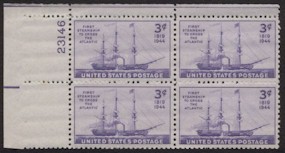
Example of a "Plate Number Block" or "Plate Block"
A relatively modern U.S. collecting specialty, dating back to 1981. At that time, in an effort to attract plate number collectors back into the hobby, the United States Postal Service began producing coil stamps with the plate number printed right on the stamp at regular intervals in the coil roll. These single-digit plate numbers (as they began) represented a full six-digit plate number. Collectors soon recognized that, because of the numbers, the PNCs' designs were different from their non-numbered counterparts and began collecting them as used singles, and also in mint strips of three and five with the number appearing on the center stamp. Such stamps are avidly collected.
Plate Proof
An image pulled from the printing plate itself. A plate proof typically includes multiple stamp images that are later cut apart, rather than the single image found on a die proof. More often than not, plate proofs closely resemble the final issued stamp.
Plate Varieties
A large class of usually small flaws that trace to the plate making process or from damage to the plate during production, which result in individualized flaws unique to one stamp or associated margin on an issued pane. Plate varieties are much more frequently encountered on older line-engraved stamps than on modern line-engraved or gravure stamps. Gripper cracks and double transfers are examples of plate varieties. Retail values tend to be modest, typically three to five times the basic retail value of the normal stamps for routine plate varieties.
Plating
The activity of collecting stamps based on their position from the original printing plate. Due to the characteristics of early stamp printing, it was possible, with study, for one to completely reconstruct, with certainty, entire printing plates, simply by studying the minor differences in design and other inconsistencies left by the siderographer.
Playing Card Stamps
Receipts for the payment of taxes on playing cards. Denominated in cents, by class, and by pack, most playing card revenues were used to seal decks of cards, so many were destroyed when cards were opened. Playing card taxes were repeated June 22, 1965.
PMS
The Pantone Matching System, a uniformly accepted system of color communication in the printing image. Each color and shade regardless of value or chroma, is assigned a number. This number is then used to print an image. Although the PMS system was designed back in the 1960s, it has only been in use by stamps printers since 1987.
A special service that was in use in some larger towns in Germany, France, and Italy, as well as several United States cities. Mail was transported through special tunnels, known as pneumatic tubes, much the same way as carriers are transported from car to drive-in windows at banks.
Pointing Finger
A general-purpose symbol used as an instructional marking on undeliverable U.S. mail that has been returned to sender for most of the 20th century. Pointing finger hand stamps exist in a vast variety of styles. They usually include text indicating why the cover is being returned, or are used in conjunction with other auxiliary markings that furnish an explanation. Position Block Any multiple of four or more stamps that have markings on attached selvage paper. These markings may include plate numbers or inscriptions, slogans, or cutting guides. Because these position blocks help identify what area of the plate produced the stamps, they are generally collected as premium items.
Post Office Parcel Card Mixture
Traditionally one of the highest quality mixtures available, these include on-paper stamps, usually collected by foreign governments, from parcel cards on packages, and sold to dealers and collectors by the kilogram. Such mixtures often contain high-value stamps.
Post Office Seals
Also known as official seals, these were initially created to seal registered packages and letters in order to thwart tampering and theft. Over the years, however, post office seals were more generally used to seal unsealed matter found loose in the mails and to repair material that has been damaged in the mail system. Post office seals are known from a number of different countries and are highly collectible. Many different varieties and privately produced types exist as well. Although most post office seals are not particularly valuable as unused or used singles, they add greatly to the value of a cover when properly tied by a cancel. Post office seals have been produced by virtually every form of stamp printing, including line-engraved intaglio, letterpress, and offset lithography. United States post office seals have been self-adhesive since 1992.
Postage and Revenue
An inscription that appears on the stamps of many British countries in particular. Stamps with these inscriptions may be used either for postage or to pay taxes and fees normally paid by revenue stamps.
Postage Due Stamp
A stamp that indicates additional postage was paid on an insufficiently franked letter or package. Collection of this fee is most always the responsibility of the receiving postmaster. Many countries, including the United States, have used postage dues over the years. Large quantities of postage due stamps have come on the philatelic market either as remainders or as byproducts of business reply mail.
Postal-Fiscals
Postal History
The exclusive study of mail rates and routes.
Postal Card
A government-produced card with the postage printed directly on it as an imprinted stamp. Postal cards usually do not bear government-printed illustrations. They are collected as entire cards, unlike stamped envelopes, which can be collected as cut squares. Postal cards should not be confused with postcards.
Postal Cancellation
Although any stamp obliteration is technically a cancellation, a postal cancel verifies that a stamp was used for postal purposes. This is particularly important for high-value British stamps that were valid for both postage and revenue uses. Such stamps with verified postal cancellations are worth far more than their far more common revenue-cancelled counterparts.
Postal Counterfeit
A forgery of a real stamp, created to defraud a postal administration or its rightful revenue. (Other types of fakes, such as forgeries or altered stamps, are created to bilk stamp collectors.) Usually, a postal counterfeit can be identified fairly easily by its relatively crude appearance compared to a genuine stamp. Both the printing (frequently different than the original) and the perforations (if any) usually do not look like the real thing. Because counterfeiting is a federal offense and copies found at the time of investigations are usually confiscated and the letter destroyed, postal counterfeits are usually quite scarce and desirable to collectors. Postally used counterfeits, or those still on cover, can sell for many times the price of those that are collected as unused examples.
Postal Stationery
A collective term for stamped envelopes, wrappers, postal cards, aerogramme's, and other postal items with stamps imprinted directly on them.
Postally Used
Stamps and covers that went through the mail, distinguishing them from what many feel are less desirable uses, such as philatelic or revenue use. Typically, a cover that has been postally used will have been used commercially. Because such covers are difficult to find in good condition, they generally command higher prices than those created by collectors for collectors, many of which never enter the mail stream. The difference in value between a postal or revenue use may well run into the hundreds of dollars.
Postcard
A privately produced item with a photograph or illustration on one side and a message area and space for a stamp on the other. Such cards are bought as souvenirs and sent or collected. Postcards should not be confused with government-produced postal cards.
Posthumous Proof
A form of die or plate proof pulled any time after a stamp has been released. In many cases, such proofs are pulled for sale to collectors, rather than production purposes. Some posthumous proofs, such as several 19th century types, were produced for exhibitions and later ended up in collectors' hands.
Postmaster Provisional's
Stamps prepared and issued by individual postmasters to fill a local need when stamps aren't available. In some cases, postmaster provisional's were released with the consent of the higher postal authorities, but in many cases such items were not sanctioned. Some of the most well-known postmaster provisional's were released and used in the United States before the first general issue of stamps was available in 1847. These include the Baltimore, New York, and Providence provisional's were released and used by postmasters during the time between secession and the release of the official CSA issues.
Potato Tax Revenue Stamps
Released in 1935, these showed payment of tax on potatoes produced in quantities larger than a farmer's allotment. These revenues are among the shortest-use stamps, lasting only slightly more than a month. The Agricultural Adjustment Act of December 1, 1935, that made the stamps possible was declared unconstitutional on January 6, 1936. It is believed that no potato stamps were actually used; all known copies are mint.
Pre-adhesive
Any postal item dating prior to the adoption of adhesive stamps in a given country. All postal items prior to 1840 are considered pre-adhesive, while some countries may have pre-adhesive covers dating to the latter part of the 19th century.
Precancel
A stamp that has been canceled or defaced prior to use. Precanceled stamps save handling time by postal clerks (because a processing step is already accomplished), which usually results in postal savings for the customer. Precancels are also a form of security device to prevent employee pilferage of postage. Because precancels have, until recent years, required a permit for use, they've been relatively safe from theft. Precancels of the United States are divided into two main categories: bureau precancels and local precancels.
Preprinting Paper Crease
Sometimes, as stamp paper is fed into the press, it creases, traveling through the press with a wrinkle where it has folded over itself. This area does not take ink. After printing, a crease may open, or it may remain creased until the sued stamp is soaked. When the crease opens, a noticeable uninked area appears where the paper was creased. Some stamps contain more than one preprinting crease, and creases on some multicolored stamps occur between application of the different colors, resulting in an odd appearance. Preprinting paper creases are highly collectible, and are most common on 19th century sheet fed stamps, although they still occur. They range in width and length from tiny to design-splitting creases that span several stamps and can run in any direction. Such creases often are mistakenly referred to as preprinting paper folds.
Press Sheet
A full sheet of stamps as it was originally printed. In the case of sheet fed presses, this is easy to determine. A webbed press sheet represents one revolution of a printing cylinder or sleeve.
Pressure Sensitive
Prime Rate
The current postage cost to mail a domestic letter weighing one ounce or less.
Printed on Both Sides
A particularly desirable form of error that occurs when a sheet of stamps is turned over and printed again on the reverse side. In some cases, this was done with an unacceptable printed image to save paper, and in others as part of the make-ready process of printing. Those that were created to eliminate waste generally are found on early stamps. Those used as make-ready should have been destroyed; they should not have been sold or distributed. A stamp printed on both sides will have a regular-reading )or positive) stamp image on both sides. This should not be confused with set-off, which is a reverse image on the back side.
Printers' Waste
Stamps that appear to be errors or freaks but are not, due to their origin. Most valid error or freak material has been sold over a post office counter and is later sold to collectors and dealers. Printers' waste, however, is misprinted material that was intended to be discarded (and was). It is usually illegally retrieved prior to incineration or other planned disposal. Stamps derived from printers' waste frequently are crumpled or have gum faults or other telltale signs of its illicit origin. Due to the nature of printers' waste, it usually sells for comparatively little, compared with legitimate errors, and is not as desirable. The most famous printers' waste are the 29-cent Richard Nixon inverts, most of which were later recalled and presumable destroyed, and the imperforate 1893 2-cent Columbians, all of which originated as waste paper.
Printing
There are two divisions of printing: direct and indirect. Direct means plate-to-paper, while indirect refers to processes that utilize a blanket or roller to transfer the image from the plate to the paper. Under these divisions, there are four main types of printing used for stamps, which include line-engraved intaglio (recess), photogravure (a form of recessed intaglio), offset lithography (surface) and letterpress (relief). Other forms of printing, such as xerography, stencil, and others, have rarely been used for stamps.
Private Die Proprietary Stamps
Revenue stamps created by individual companies to show prepayment of taxes on matches, playing cards, patent medicines, perfumes, and other items. Many companies produced their own stamps because they not only received a discount for producing their own, but also were able to use their stamps as a form of advertisement. These items are also known as Match and Medicine stamps.
Private Overprints
A form of precancel found on several types of revenues, but may be most prominent on Battleship revenues. About 275 firms precanceled their proprietary stamps before placing them on their product. Although these items are highly collectible and sought after, few sell for very high prices.
Private Perforations
Any form of perforation applied privately. During the early part of this century, the United States Post Office Department produced fully imperforate stamp that were sold to private vending and affixing companies. The vendors then applied the type of perforations that worked best for their equipment. These items, also known as vending and affixing machine perforations, were created primarily during the years between 1906-23, prior to the advent of rotary press continuous coils and the standardization of most stamp vending and affixing machines. These included forms of stamp separation that resembled traditional perforations, as well as unusual patterns, including large, oblong hyphen-hole perforations. Many other forms of private perforations also are known from numerous countries. Some were created out of need, while others were created primarily as philatelic souvenirs. Private perfs have always been popular with collectors but have been frequently faked. In addition, because some imperforates are more valuable than private perfs, many fake imperforates have been created by trimming perforations from these stamps.
Proof
Any stamp image printed to check image, color, quality, design, or any other factor that could affect a final printed stamp. Proofs may be pulled at any point in the stamp designing of manufacturing processes, including years after a stamp issue has been produced. There are many different types of proofs, including progressive die proofs (taken as a design is being engraved), die proofs (from the final engraving), trial color proofs (to check the desirability of different colors), plate proofs (from printing plates), posthumous proofs (made long after a stamp was issued), and others. Both die and plate proofs may also exist as essays, those varieties of stamp images produced prior to the final version.
Propaganda Forgery
A form of faked stamp used for political purposes. In some cases, these stamps are nearly exact replicas of genuine stamps, except for some minor design difference intended to influence opinions. IN other cases, propaganda forgeries almost look like caricatures or parodies of the actual stamp they imitate. Some propaganda forgeries are intended to be used on mail, both to defraud and influence, while others are passed out like labels. Numerous propaganda forgeries were created during World War II. Most are scarce and highly desirable.
Proprietary Stamps
Revenue stamps created for the purpose of paying taxes on canned goods, matches, medicines, perfumes, playing cards and other items. As of 1871, when the second issue of documentary stamps was released, proprietary specific-use stamps.
Protectorate
A country or region governed, guided, protected, or controlled by a larger, stronger country.
Provisionals
Stamps that are issued, or overprinted, for temporary use until regular issues are available. The need for provisional stamp issues usually revolves around war or political upheaval.
Provisional Overprints
Refers to two types of U.S. revenue stamps. The first type includes printed name or initial overprints on first-issue revenues. These were primarily produced by medicine companies for use until their own proprietary stamps were printed. The second type of provisional overprint occurred as a result of the Spanish-American War. U.S. postage stamps were overprinted "I.R." for use as revenue stamps until new revenue stamps could be printed and distributed.
Pulled Perf
This is perhaps the most damaging form of perforation fault. When a stamp is poorly separated, the perforation tooth may have the paper fibers pulled from the stamp itself, leaving an end that appears shorter than the recessed portion of a perforation hole. Even if one pulled perf is present on a stamp, it is considered a major fault.
Example of a stamp with a "Pulled Perf"
One of several forms of destructive cancels, or defacements, used on stamps. A punch cancel is a cancel that consists of a hole punched in the stamp. In some cases, this is the only form of defacement used. In others, a punch is combined with an ink cancel. Punch cancels are one of the most effective forms of revenue protection because the reuse rate on stamps canceled in such a manner is very low. Punch cancels are also used to deface mint stamps that have been sold into the stamp collecting hobby as remainders. The most commonly encountered form of this defacement practice is found on telegraph stamps of the world. Punch cancels can include perforated initials, circular punches, or any other type of hole. In most cases, stamps with punch cancellations are worth considerably less than those with normal manuscript or hand-stamped cancellations.
Q
A type of paper with intersecting vertical and horizontal lines that form small squares or rectangles. These rectangles may either be formed by a watermark or by a pattern of oil or lacquer. A number of French colony stamps of the turn of the century were printed on a quadrille paper. The term also applies to a specific form of album page with a lightly printed network of squares. This quadrille pattern is used by collectors as a guide for centering and mounting stamps on pages.
Railroad Cancel
Postal cancellation generally applied in a working railway post office (RPO) aboard a train.
Railway Post Office (RPO)
A small working office on board a train. These post offices on a single railway car sorted, cased, canceled, and bagged mail while the train was en route. Railway post office service was phased out during the 1960s.
Received Marking
A special postmark applied to the back of a cover that denoted the receiving town name, date, and frequently the time of arrival. Historically, this has been an important means of documenting mail delivery. Although received markings are still used in some countries and are sill occasionally found on United States covers, the practice was officially discontinued prior to 1920.
Recess Printing
Rectification Tax Stamps
Similar in purpose to distilled spirits stamps but showed payment of taxes on those distilled spirits that were to undergo additional distilling, usually in the form of blending.
Recut
A stamp design that has been repaired, retouched, or otherwise strengthened or altered on the printing plate. Because the alteration has been done by hand on the plate itself, the printed stamp usually will be visually different from its counterparts in some way. Recuts may be minor or major and, because they are constant varieties, they will always appear on stamps form the same position and plate.
Redrawn
The reworking of an existing stamp design. Rather than going back to the printing plate, transfer roll, or even original die, a stamp producer will base new artwork on an existing stamp design; the result is a similar but face-different stamp. One of the more well-known examples of a redrawn stamp is the U.S. 5-cent Washington of the 1965 Prominent Americans series. The original design was thought to make Washington look too swarthy. As a result, the redrawn design, which appeared in 1967, features a new and improved clean-shaven portrait of Washington.
Re-Engrave
To remake all or part of a printing plate or die by making additions or corrections to the design without significantly changing it. A re-engraved stamp may have small details changed, or it may involve major work.
Registered Mail
A service added to basic first-class service for which the sender is given a numbered receipt that acknowledges the monetary value of the item being mailed. A signature is required of the addressee upon delivery, and the mail is tracked throughout its journey. If a registered item is lost in handling, the sender may receive compensation for the item. Registered mail, in use by many countries, is used to mail particularly valuable items. Many countries have released registry stamps to pay the registry fee. Registered mail may be sent with or without postal insurance. Covers bearing registry markings and the appropriate postage are frequently prized by postal history collectors.
Registration
This term, used as a noun, refers to how closely in alignment different colors appear on a multicolored stamp.
Regular Issue
Reissue
A stamp that was previously withdrawn from government sale and is later placed on sale again. A reissue does not involve the reprinting of a stamp and is indistinguishable from the original other than by postal use.
Remainders
Stamps left after an issue has officially been withdrawn from sale. In some cases, devalued remainders are sold in quantity to dealers, or are canceled (or otherwise defaced) and distributed to the hobby through other channels.
Repaired Stamps
Defective stamps that have been altered or enhanced in some way to minimize or disguise their flaws. Many kinds of different philatelic repairs have been attempted, with results that range from dreadful to virtually undetectable. Such repairs include (but are not limited to) the filling of thins, the sealing of tears, and the replacement and reperforation of missing margins. Many in the hobby regard stamp repairs unfavorably, chiefly because of the potential for fraud if a repaired copy is offered as a more valuable sound example of the same stamp. Others, however, regard repaired stamps, bought and sold as such, in the same way as one would a repaired antique chest or a piece of old porcelain with a sealed chip or crack - as a less valuable, but more affordable, restored version of a collectible stamp.
Reprint
A stamp printed from the original plates often after the issue has become obsolete. Such stamps are not intended for postal use; rather, they are created for collectors as philatelic souvenirs.
Retouch
This form of printing plate repair, usually involving the manual strengthening of a design element, is far less severe and less noticeable on finished stamps than any form of recutting or re-engraving. The latter repairs, often major, create stamps with significant design flaws or differences from normal examples. Like any repair or damage to a plate, however, a retouch will always appear on the same stamp position from the same plate.
Return Receipt
A mailing service (available for a fee) where a special penalty imprinted postal card is attached to the mail piece, which is then signed by the recipient and sent back to the original mailer.
Revenue Stamped Paper
A number of different types of items released with stamped, inked impressions to show payment of applicable tax on the paper itself. The most common form of revenue stamped paper is the bank check. Railway tickets and other documents also exist as revenue stamped paper. These items should be saved intact because trimmed or cut pieces have little value.
Revenue Stamps
Special stamps, utilized worldwide, to pay duties or taxes on various good sand services. These stamps, affixed to documents or receipts ( and canceled), show prepayment of these taxes. Revenue stamps may be found on liquor, tobacco, playing cards, stock certificates, deeds, patent medicines, and many other items. Postage stamps used for revenue purposes are called postal-fiscals; revenues used for postage are called fiscal-postals.
RMS
Abbreviation used in postmarks for Railway Mail Service.
Rotary Perforations
A form of perforation applied by a perforating wheel that has a grinding motion. The holes from such perforators are generally rougher than those applied by stroke perforators and are slightly distorted in shape.
Rotary Press
This form of printing involves the use of joined, curved printing plates that print on continuous rolls (webs) of paper. Because the plates are slightly distorted when they are bent, stamps printed from such plates are usually slightly taller or wider than those produced from flat plates.
Rough Perforations
A type of perforating, intentional or non-intentional, that leaves jagged perforation holes.
Roulette
A form of stamp separation where dash-like cuts are made in the paper to allow stamps to be separated without tearing or cutting. Roulettes serve the purpose of perforations, but, unlike perforations, no paper is removed during the process. The most common form of rouletting is a series of slits applied by a toothed wheel, but there are several others.
Row
A horizontal, single-stamp-tall multiple of stamps from a sheet, pane, or booklet.
RPO
Abbreviation used for Railway Post Office.
Sample Overprint
In 1889, at the order of the United States Post Office Department, the American Bank Note Co. prepared special printings of a range of earlier Bank Note issues that had been produced between 1879 and 1888. Copies of U.S. stamps issued since 1851 that were subsequently circulated for official, promotional, or educational purposes had been overprinted "Specimen." This special printing had never been intended for postal use of any kind; however, it apparently was felt that a "Specimen" overprint was inappropriate for use on these stamps. To ensure that they would not be confused with regular stamps and postally used, therefore, these stamps were given "SAMPLE" and "SAMPLE A" overprints in red or blue. (On four of them, all or part of the overprint appears in manuscript.) The stamps are listed with specimen stamps in the Scott Specialized Catalogue of United States Stamps & Covers.
Sawtooth Roulette
A roulette that leaves angular, pointed edges.
Any non-postal labels used to raise money for charity or to decorate or seal envelopes.
Sealed Coil
A full roll of coil stamps that is in the original condition it was when sold at the post office. The size of the roll and characteristics can differ, but it will bear some form of seal, label, or wrapper. Some collectors save full, sealed coil rolls, and others purchase them to break down into desirable components. Sealed coils can be found from virtually every country that has produced coil stamps. With rare exceptions, most sealed coil rolls do not command premiums over the prices of their component stamps.
Second Issue
United States revenue stamps released in 1871 to replace the first issue series. The second issue stamps differ slightly in design from first issue examples and were printed on chameleon paper with silk fibers. This was intended to prevent unlawful cleaning of the cancels and subsequent illegal reuse.
Secret Marks
Tiny marks on stamps added by the artist or engraver to allow two similar designs to be told apart. These are frequently used with specific reference to early U.S. 19th century bank not issues. Some engravers also hide heir names or other details in stamp designs, only to be discovered later by sharp-eyed collectors. These, too, are known as secret marks.
Security Paper
A catchall term that refers to different types of paper, including silk, chalky, and prephosphored papers, among others, used to prevent counterfeiting of stamps.
Selective Block Tagging
Although similar to block tagging, this type of application involves the cutting of tagging rollers on a pantograph machine to leave untagged areas on printed stamps. Examples of this type of tagging include the 1988 Classic Autos booklet and the 13-cent Eagle and Shield definitive. The untagged area left by selective block tagging allows the cancellation ink to adequately permeate the stamp paper to prevent illegal reuse.
Self-Adhesive Stamps
Stamps with pressure-sensitive adhesive. Stamps with self-adhesive gum require no moisture to apply. They feature a sheet of silicone-coated backing paper beneath that keeps them intact until they are used. The first self-adhesive U.S. stamp, a pre-canceled die-cut 10-cent Dove Weathervane introduced for use on Christmas cards in October 1974, met with only modest success, and the gum has tended to produce mottled brown spots on mint copies. Improved self-adhesive stamps issued during the last decade, however, beginning with the 1989 25-cent Eagle and Shield, have become popular with postal patrons. Self-adhesive technology is relatively new to stamps, but currently accounts for the vast majority of new postage stamps produced in the United States. The first self-adhesive stamp was released by Sierra Leone in 1964 to salute the New York World's Fair.
Selvage
The unprinted paper surrounding the stamp in a pane, sheet, or booklet. The term also refers to the paper that borders sheets and pans of stamps as they are printed.
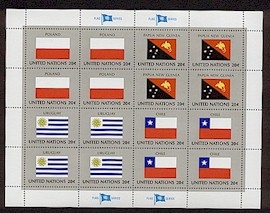
Example of "Selvage" that borders a small sheet of stamps
A postage stamp that also serves as a receipt for the prepayment of an additional fee, usually to benefit charity. This additional fee frequently is represented in the stamp's denomination as a "plus" indicator. Thus, a stamp with 3+2c denomination denotes 3 cents postage and 2 cents to a specific charity.
Separation
See Perforations and Roulette.
Series
A grouping of stamps by design, theme, or other means, intentionally released as a group over a period of months or years.
Serpentine Roulette
A form of roulette consisting of wavy lines.
Serrated roulette (or Saw Tooth Rouletting)
A form of rouletting, probably in which the simulated perforations fit together in an interlocking pattern of jagged right angles.
Service
When overprinted on a stamp, the term generally means "on government service." The overprint indicates the stamp is valid for use only by a governmental official.
Service-Inscribed Stamps
Stamps containing text indicating their intended function or rate, either as an integral part of the stamp design (as in the "BULK RATE" inscription on the 7.9-cent Drum definitive) or applied as an overprint (as in "CAR-RT SORT" Bureau pre-cancel.
Sesquicentennial
Stamps released to mark the 150th anniversary of a significant date or event.
Set
A grouping of stamps all belonging to the same issue or series.
Set Off
Often inaccurately referred to as offset, set-off is a phenomenon that occurs when freshly printed sheets of stamps are stacked before the ink has completely dried. The design from a bottom sheet frequently, partially or fully, transfers to the un printed side of the sheet directly above it. The more complete the impression, the more desirable the freak is to collectors. The most pronounced examples of set offs are caused by a printing plate leaving a fully inked impression on an underlying roller when the press skips a sheet of paper. Subsequent sheets then receive normally inked impressions on the top side, as well as a reversed impression on the gummed side, where it has come in contact with the roller. Subsequent offset impressions fade as the ink on the roller is exhausted. These freaks, which are usually strong impressions, are greatly sought after. A third form of set off can be simulated by normally printed stamps sticking together as a result of high humidity. When pulled apart, they can give the appearance of an offset, but they are not true set offs and have no philatelic value. Another similar form of setoff can also occur through improper storage of stamps in albums. Under pressure, stamp designs transfer from the face of the stamp to the next album page. This form of setoff is not desirable.
Se-tenant
Two or more stamps of different designs or types that are attached. Se-tenant issues have become more popular in recent years with a number of different countries. Unintentional se-tenants also exist. If different die types or major variations occur on different stamps from the same sheet or pane, a pair of stamps exhibiting these different characteristics are considered to be se-tenant.
Sewing Machine Perfs
Privately produced perforations on imperforate second issue revenues. It is believed that the buyer of what would have been imperforate errors ran the stamps through a sewing machine, letting the needle to the perforating.
Shade
A color variation from the normally released version. A shade by nature refers only to one particular mix of hue and chroma, but is compared by collectors to what is considered normal for a stamp.
Sheet
A complete printing sheet of stamps as it comes off the press. It may well be sliced into post office panes at a later date.
Sheet Files
An oversized glassine envelope capable of holding an entire mint pane.
Sheetfed
A flat-plate press that prints stamps in individual sheets, as opposed to a webfed rotary press, which utilizes large rolls, or webs, of paper.
Ship Cancel
A postal marking applied aboard a ship. Such markings usually give not only the date, but also the name of the ship and, occasionally, the shipping line name. Such cancels are usually considered desirable.
Short Perf
Poor separation of attached stamps may result in one perforation tooth that is shorter than its neighbors. While a short perf is considered a fault, it may not seriously affect a stamp's value negatively. Short Set A grouping of stamps from the same issue or series that may be missing one or two values, usually the high values in the packet trade.
Siderography
The practice (or art) of creating printing plates from the original die by using transfer rolls to rock stamp images onto the printing plate. Most siderography is now done by machine, rather than by hand.
Silk Paper
Revenue stamp paper that includes silk fibers. (The early experimental silk paper, found on first issue revenues and some private die proprietaries is difficult to distinguish.) In many cases, only a single fiber or two may be found on one stamp. Later silk paper types have numerous, highly visible silk fibers appearing in the paper.
Silver Tax Stamps
Used to pay tax on the net profit on the sale of silver bullion (1934-63). Silver tax stamps were to be affixed to the transfer memorandum. Although the last silver tax stamps were released in 1944, their use was continued until June 4, 1963.
Skips
Stamps that have been postally used but were not canceled. Although the use of skips is illegal, many people view them as found money. Once removed from the envelope, there is no way to distinguish a skip from an unused stamp without gum.
SL
Abbreviation for straight line, referring, for example, to a town marking consisting of a straight line.
Sleeper
A stamp that is in short supply or inherently desirable for some reason, but the value has not yet been discovered by collectors.
Slogan Cancel
Metal die hub cancels that bear some informational, advertising, promotional, or propaganda message. They are found on the covers of many countries. Slogan cancels may also be hand-stamped, but do not occur as frequently as machine cancels.
Smears, Blobs, and Blotches
Caused on stamps by excess ink, by cleaning solvent or other chemicals, on the printing plate at some point during production.
Snowman Perforations
A perforation anomaly that appears on some stamps of the 1990s processed on what is known as an APS grinding perforator. The name comes from the appearance of the anomaly: stacked perforation holes that resemble a sideways snowman. The APS grinding perforator does not punch holes in the stamp paper; it grinds out the holes, with the use of three rotary blades and a perforation pattern die that pushes the paper into cutting blades, producing dust, rather than tiny circles of paper. The practice, known as skiving, was borrowed from the leather making industry, where thin layers of skin are removed from the hide. Cutting heads are positioned so that the web first travels pas one cutter, grinding away the paper and perforating that portion of the web first. The web then travels under a take-up roller to the remaining two cutting heads. If the paper slips slightly out of alignment, or if the take-up rolls develop play or chatter, the edges of the blades, which normally overlap two or three holes, double-cut the stamps out of alignment, causing the snowman affect of slightly doubled perforations.
Soaking
The process of removing stamps from their envelope backings by immersing in cool water for a time. Soaked stamps are then placed face down on absorbent paper to dry.
Socked-On-the-Nose
Solvent Smear
The most dramatic form of color smear, these result from use of solvents to clean printing plates. After cleaning, solvent remainders thin printing ink to the point that t messily smears across the surface of the finished stamp. Like all freaks, these items are supposed to be cut from the printed web of stamp paper and destroyed, but they occasionally slip though, to the delight of collectors.
Souvenir Card
Special items with philatelic interest, usually released in conjunction with philatelic exhibitions. Souvenir cards may or may not depict stamps. In some cases, such as those produced by the Bureau of Engraving and printing, souvenir cards bear die imprints of actual postage stamps. Souvenir cards are not valid for postage, but are simply intended to be attractive souvenirs.
Souvenir Panel
A specific product of the United States Postal Service. A souvenir panel is a specially engraved card, with text relating to a stamp issue. A mint block of four stamps is then added to the panel and sold as a souvenir.
Souvenir Sheet
Typically a small pane or sheet that contains one or more stamps, released for a specific event or purpose. The margins of souvenir sheets frequently are very large and contain printed information describing the stamps, the purpose of issue, or the special event being commemorated. The stamps in a souvenir sheet may either be perforated or imperforate, and, with rare exceptions, are valid for postage, either as part of the sheet or cut out and affixed separately. In many cases, stamps in souvenir sheets reproduce older stamp issues. Souvenir sheets have been issued by most countries at one time or another, frequently in celebration of a large stamp show.
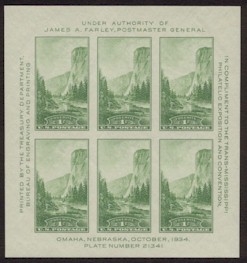
Example of a "Souvenir Sheet"
A damaged or inferior copy of a stamp valued chiefly for its ability to fill as spot in an album. It is assumed that the stamp will be replaced when a better example is obtained, unless it happens to be very rare or valuable.
Spandrel
The corner area between the vignette (or central oval) and the outer frame line or border. This corner area frequently includes decorative design elements.
Special Delivery
A special service of mail used when a sender wishes a communication to be delivered quickly, by messenger, upon its arrival at the post office. Many different countries have released special delivery stamps for this service. In recent years, special delivery has fallen out of favor with mailers (and was discontinued in the United States in 1997). Expedited services, such as Express Mail, have largely replaced the need for special delivery.
Special Handling
Stamps representing a special fee for a service used on fourth-class mail that gives it the same handling privileges as first-class mail.
Special Printing
Stamps created for distribution to dignitaries as special favors, or for sale (often long after the fact) to collectors. They may or may not be valid for postage. Such stamps also may or may not be produced from original printing plates. Examples of special printings include the 1875 printings of numerous U.S. stamps (including newly engraved reproductions of numbers 1 and 2). The exact line of what constitutes a special printing is not always clear. The so-called Farley's Follies issues of the 1930's, which were produced to make stamps given to dignitaries available to collectors, are considered by most to be special printings. The intentional printing of the 1962 Hamarskjold Invert is, in fact, a special printing, but is not generally acknowledged as such.
Special Stamps
There is some discussion among collectors over special stamps, a not-entirely-satisfactory term coined by the U.S. Postal Service. These stamps fall somewhere between definitives and commemoratives in both size and use. They may be reprinted from time to time, like definitives, but are issued in a very limited range of denominations and have a more specialized function or intended period of use than ordinary definitives do. The Christmas stamps issued since 1962 and the Love stamps issued since 1973 are examples of U.S. special issues.
Specialist
A collector who studies and gains special knowledge in one particular area. This can include country or topical collections as well as specialized studies of a single stamp or series. In many cases, the dedicated specialist is able to serve as an expert in his or her chosen specialty.
Specimen Stamp
A stamp that has been defaced by means of an overprint, perforation pattern, or other obliterations for the purpose of creating samples to be given to postmasters, philatelic agencies, and others.
Speculative Issues
Stamps that are released more for their revenue-producing appeal than to carry mail. Traditionally, there has been a great deal of distaste on the part of collectors for speculative issues. Efforts to deter collectors from buying such stamps have been made but have consistently failed.
Splice
The splicing or joining of paper by the manufacturer or printer, typically in web-fed rotary printing, by glue or tape. Tape splices are known in a variety of colors and types of tape including paper and plastic. Splices are often referred to as paste-ups, a term originating from a time when most splices were made using glue or paste. Today, most, but not all, splices are made with tape. Splices on modern issues are usually the result of two webs of paper being joined during the printing process.
Split Grill
A term used to describe the visual effect of a misregistered grill that is split between two stamps. Such freaks are avidly collected by specialists.
Spurious
This is a catch-all term to describe stamps that have been manufactured or altered to bilk collectors or postal administrations.
Squash-Effect Doubling
A freak effect (also known as halo effect) that quite frequently is mistakenly referred to as a double impression error. In letterpress printing, the inked portion of the plate is raised, accepting the ink and depositing it on the surface. If the plate contacts the paper with too much pressure, various forms of the squash effect can occur. In most cases, the darker, hard edge surrounding the printed area gives the illusion of double printing. Although most forms of squash-effect doubling have little value, the most pronounced examples will sell for slight premium.
Stamp Album
A cover that does not bear an adhesive or imprinted postage stamp. For many years, stampless covers were shunned by collectors because they bore no stamp. They are now respected and are greatly sought after by many collectors for their postal history value. Most stampless covers predate adhesive postage stamps. In many cases, stampless covers may not be covers in the true sense of the word; they are folded letters.
Star Plate
A marginal marking on United States stamps, identified by a hollow or sold star appearing next to the plate number in the selvage. Beginning in early 1909, the Bureau of Engraving and Printing began experimenting with printing plates with varying spaces between stamp images. This was done to reduce the effect of normal shrinkage of paper moistened during printing, which adversely affected the perforating process. The paper, it seems, shrank more near the edges than in the center, making poorly perforated stamps commonplace. By varying the longitudinal between stamps (3 mm between the six outer columns of stamps, 2 mm for interior positions), BEP hoped to minimize uneven shrinkage and produce postage stamps that were better centered. The star was added to the plates to allow workers to differentiate between the older plates and the new ones with wider spacing's. Most stamps printed from star plates are scarcer than normal ones, because not as many were saved by collectors. They are most commonly collected in plate blocks and strips, but also in pairs and strips showing the spacing differences.
State Revenues
Revenue stamps issued for use under state authority. State revenues exist in as many types and classifications as federal ones and more. These items, ranging from mattress stamps to egg tax stamps, may be used in conjunction with federal issues or by themselves. Many state revenues, such as New York stock transfer stamps, are easy to locate and are inexpensive, but some are rare and costly.
Stitch Watermark
An unintentional form of watermark created by seams in the wire mesh upon which paper is formed in the papermaking process. Stitch watermarks appear (under watermark detection fluid) as a series of short lines across the stamp. Stamps with stitch watermarks are uncommon and frequently sell for a premium over those without. Few stitch watermarks are known on stamps printed after the turn of the century.
Stock Book
A stamp accessory that is a loose-leaf or bound binder, containing specially constructed pages with strips of glassine or other materials, forming a lipped edge. Stamps may be placed under these strips for safekeeping until they are mounted, sold, or traded.
Stock Transfer Stamps
A form of documentary revenue stamp specifically created and use din relation to the sale and transfer of shares and certificates of stock. Stock transfer stamps exist as both federal and state revenues.
Straight Edge
Any perforated stamp with one or more sides without perforations. Straight edges occur both naturally and as damage to a stamp. As damage, a straight edge is easily and often accidentally created by a pair of scissors or a letter opener. Natural straight edges are created when large printing sheets are cut apart into post office panes. If there is no perforated selvage gutter between panes, then one or more sides of a pane will have a straight edge. Frequently, such straight edges also feature part of a cutting guide line, which helps establish it as a legitimate straight edge. Most modern-day self-adhesive stamps and stamps from booklets have naturally occurring straight edges, produced when the panes are separated. Although many collectors consider straight-edged stamps undesirable, others seek them out because such stamps can give vital plating and position information on some issues.
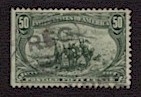
Example of a stamp with a "Straight Edge"
The imprint left by a hand stamp device on a cover or stamp.
Strip
A horizontal or vertical multiple of three or more stamps in a row or column.
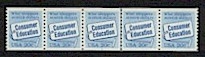
Example of a "strip"
A form of perforator that perforates stamps by an up-and-down stroke motion, rather than a grinding rotary movement. Perforations created by stroke-type perforators are usually perfectly shaped.
Stuffer
An envelope-sized piece of cardboard or other stiff material used to keep an envelope or cover from being creased or damaged in the mail stream. The use of stuffers is most common for philatelically created items, such as first-day, first-flight, and special-even covers.
Subject
An individual stamp image as it is rocked into the printing plate; thus, if a printing plate can produce 400 stamps with each impression, it is said to have 400 subjects. Subject also refers to the person, place, or thing pictured on a postage stamp.
Substrate
Any type of material upon which a stamp image is printed. Although the most common substrate is paper, wood, plastic, and other materials have been used to print stamps over the years.
Superb
A term that relates more to centering than to overall condition. A stamp that has superb centering is virtually perfectly centered within the perforations. Imperforate examples will also be virtually perfectly centered within their margins. Superb stamps frequently sell for large premiums over catalog values, which are usually based on either fine-to-very fine or very fine centering.
Surcharge
An overprint that changes the denomination of a stamp. In many cases, a surcharge increases the face value of a stamp, but it also may lessen or confirm the printed value as well. A surcharge may even be used to change the form of type of currency indicated on a stamp.
Surface-Tagged Paper
A type of postage stamp paper with the phosphorescent tagging applied before stamps are printed on it; thus, the printed image sits atop the taggant, rather than under. Because the taggant is on the surface of the paper only, it is not found throughout the various layers of paper fibers as it is with embedded-taggant paper. Such application of taggant is analogous with painting a fence.
Sweat Box
See Humidor.
The perforations on stamps with this type of separation are interrupted with holes of different sizes or shapes at regular intervals. These holes may be round or elliptical, and either larger or smaller than the surrounding holes. Syncopated perforations may be applied as a security device, for use in vending and affixing machines or as a novelty.
T
A non-postal pictorial or text label attached to a postage stamp for various purposes. In recent years, tab has become the standard terminology to refer specifically to the labels on the stamps of Israel.
Tagging
On U.S. stamps, tagging refers to the intentional application of phosphorescent compounds that react when exposed to short-wave ultra-violet light on stamps or other postal paper. This is a photochemical reaction that can be detected by modern mail-handling equipment and used to correctly orient a piece of mail for canceling and sorting. In block tagged stamps, a rectangle of transparent but UV-reactive ink (called taggant) is applied. In overall tagging, as the name implies, the taggant covers the entire surface of the stamp, usually including the margins. Many recent stamps are printed on prephosphored paper, in which taggant is already present or is applied before printing. For stamps of other countries, tagging also refers to intentionally applied luminescent material that may be either fluorescent or phosphorescent. Most forms of tagging are invisible to the naked eye.
Tagging Ghost
The ghost image of a stamp image, text, or plate number, picked up wet from freshly printed stamps by the tagging roller and deposited on the next impression. Tagging ghosts are frequently mistaken for double printings, but are a form of set-off freak. Tagging ghosts that are quite clear are highly collectible.
Target Cancel
A cancellation marking composed of a series of concentric rings. Target cancels are a form of mute cancel that has been used in many countries for many years.
Taxed Photographs
Photographs from the Civil War era bearing revenue stamps on their backs. The tax act of 1864 (one of the later taxes of the Civil War) levied certain taxes on two arbitrary categories of photographs. One category included photos of artwork, engravings, and other types of illustrations. The other category covered all other types of photographs. It is the second type that required the use of revenue stamps. The tax (with one change in 1865) was effective from August 1, 1864, until July 31, 1866. Tax paid revenues differ from most other types in that they are not denominated in dollars and cents. Because of this, taxpaids are not listed in the Scott catalog - but that doesn't mean they don't have a strong devoted following. Taxpaids exist for many types of food, alcohol, and tobacco products, and each classification has many types.
Teeth
The projecting remnant of perforations along the edge of a stamp, formed by what was the bridge of paper between the perforations on un separated stamps. Each individual tooth gives a stamp its own personality and can be used much like a fingerprint for identification of a specific stamp.
Telegraph Stamp
It has been stated numerous times that telegraph stamps are to telegrams what postage stamps are to letters. This is the most direct form of payment representation possible. As telegraph service mushroomed during the late 1800s, so did the number of telegraph companies and use of telegraph stamps. These items were in use from about 1870-1947. As smaller companies were swallowed by larger ones, the number of stamps dwindled. In addition to mint and used, many telegraph stamps also are known as remainders. Many of these have a hole punched in them. (See also Collect and Duplicate)
Tercentenary
The 300th anniversary of a birth of other event.
Territorial Mail
Those covers and postal markings applied by active post offices in areas that have not yet been admitted to the union as states. In the case of Alaska and Hawaii, for example, pre-1959 postmarks are territorial's. Generally, territorial's are scarcer and more desirable than those markings applied after statehood. This is particularly true of the older states and those from the American Frontier.
Test Coil
One form of testing stamp created for experimental use. As with any test stamp, the primary reason for the existence of a test coil is so that tests can be run without using postage stamps, which could be misappropriated. Test coils in the United States have been created to test printing and processing equipment at the Bureau of Engraving and Printing, the vending machines of the U.S. Postal Service, and the stamp-affixing machines of many large mailers. In most cases, test stamps are never intended to reach the philatelic market and, in fact, such items were heavily controlled until the 1970s. As more and more material began to leak out (probably from private mailers), more collectors were able to obtain it for their collections and interest in these cinderella's has grown steadily since.
Tete-beche
Attached stamps that have designs inverted in relation to each other. This French term means head-to-tail. Tete-beche stamps may occur as a natural part of stamps production, such as some booklet formats and in the production of triangular stamps, or they may occur as a result of production error. Such errors normally are scarce. Tete-beche stamps are generally collected either as pairs, or as triplets, with the upside-down stamp in the center.
Thatcher Ferry Bridge Error
Late in 1962, almost immediately after the United States Post Office Department intentionally printed millions of Hammarskjold invert stamps to destroy the value of the error, panes of the Canal Zone stamp featuring the Thatcher Ferry Bridge were discovered with the silver bridge omitted. Once again, the USPOD was prepared to ruin the value of the stamps by intentionally printing millions more. Legendary dealer H.E. Harris intervened and immediately filed suit against the USPOD to prevent this from occurring. In the landmark case, which Harris won, the USPOD was prevented from ever reproducing errors to destroy collector value. Today, the Thatcher Ferry Bridge error is worth thousands, while the Hammarskjold invert is not worth significantly more than a normal example.
Thematic Collecting
Similar to topical collecting, thematic collecting strives to tell a complete story; for example, a thematic collection dealing with smoking would include not only topical items, but also historical related postal items. Thematics leave more open to an individual's own interpretation than the strict collecting of topical material that simply depicts the desired subject.
Thermographic Paper
A type of paper where the image is produced by the use of heat, laser beam, or pressure. Such stamps are difficult to store for long periods of time without damage.
Thin
Damage caused by the careless removal of a stamp from its cover or of a hinge from the stamp which leaves part of the stamp paper thinner than normal. Since the damage occurs on the back side of the stamp, it is not always visible when the stamp is viewed from the front. Thins are a form of damage to a stamp and lower a stamp's value. Sometimes referred to as a "thin spot" of "skinned spot."
Three-Dimensional Paper
Gimmick stamps created primarily during the 1960s and 1970s by countries looking to boost sales of their stamps to collectors. A special ridged plastic was used to reproduce a stamp image in relief. Such stamps have ceased, because hologram technology makes 3D images much easier, and in most cases, less expensive to reproduce.
Tied
A term denoting a marking on a cover that marries or ties the stamp or other item to the cover or card. The ink from the device carries over onto the cover, leaving the impression of being tied. Tied seals, stamps, and other items are important for documenting whether such items truly originated on a given cover.
Tobacco Sale Tax Stamps
Used for a short time in 1934 to show payment of tax paid for tobacco produced in excess of stated allotments. This tax was declared unconstitutional on December 1, 1935. Tommy Gun Stamp Specifically refers to a $200 revenue issued in 1934 to show payment of a fee for a permit to own a submachine gun.
Tongs
A special type of tweezers specifically designed for use by stamp collectors. Unlike tweezers, tongs are made under more exacting standards and come in a number of styles, from spade tip to needle nose. Also, and more importantly, the surface of a tong tip is never textured. These ridged edges, found on most tweezers, will harm stamps. Do you need some tongs? Championship Stamp Supply offers dozens of different tongs for stamp collectors.
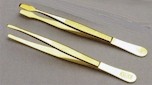
Example of gold plated "Tongs"
This increasingly popular form of collecting involves gathering stamps, postmarks, meters, and other postal items that illustrate one particular topic, such as cats, dogs, boats or spaceships.
Torn Stamp
A generally unacceptable condition of a stamp, rendering it a space filler worth a tiny fraction of a sound copy's value. In some rare cases, such as the early stamps of Afghanistan (where postal clerks tore stamps with their teeth), a tear, punch, or other damaging defacement served as a customary form of stamp cancellation.
Town Cancellation
The most common form of postmark, giving the town name, and usually the state and date mailed. Most town-name postmarks are hand-stamped markings.
Training Stamps
These items, which are still produced in many countries, date back to business schools of the 19th century. Training stamps are now primarily crated in some countries for postal clerks in training. Such clerks, both civilian and military, frank, process, and cancel dummy mail franked with training stamps. Training stamps may be actual postage stamps that have been deliberately defaced for use in postal training, or they may be cinderella items that are designed and printed specifically for that purpose and have no true postal value. All are quite collectible. Because they both display block lines, some collectors confuse the barred training stamps of Great Britain with the graphite line varieties of the same countries.
Transfer Roll
Used in the siderography process to transfer the image from an engraved die to a printing plate. After the steel die is hardened, a softened transfer roll is rocked in creating a positive relief image. Once several entries are placed on the transfer roll, it is hardened and is then rocked into the softened plate, creating an incised reverse image.
Transient
These are generally minor varieties that appear on stamps at random, as opposed to constant varieties, which always appear on the same stamp in the same place in each pane or sheet printed. Transient varieties include ink smears, blobs, streaking, and other production-related anomalies.
Transit Marking
A special order form of postmark that frequently contains the word "transit" in the device itself. The marking denotes the piece is en route and sometimes indicates a delay of some sort. Although some postmarks are still added en route, arguably classifying them as transit markings, the devices themselves and the practice were officially discontinued many years ago.
Transition Strip, Block, or Multiple
A multiple of stamps of any size that shows a change from one form to another. The strip may be from sheet, booklet, coil, or any other format of stamps. The transitions referred to are often connected with major errors, such as a transition from perforated to imperforate stamps, or from full-color to color-omitted stamps. Error transition strips may be complete in as few as three stamps or as many as 20 or more. Such strips are usually scarcer than the error itself, so error transition strips frequently sell for a premium above the error itself, because of the amount of important information they supply.
Trial Color Proofs
Tri centennial
Stamps released to mark the 300th anniversary of a significant date or event.
True Franking
A mailed item that accurately reflects the postage paid by its stamp. Thus a 16.7-cent piece of mail bearing a 16.7-cent stamp is an example of a true franking.
Turned Cover
A cover that has been turned inside out for reuse. This usually has been done in times of hardship, such as war or natural disaster. Some turned covers also have been created specifically by collectors as novelties.
Typography
The obsolete term for letterpress printing, typography now deals with lettering and type sales.
Typeset
The obsolete term referring to stamps printed by letterpress (formerly known as typography).
Ultraviolet Lamp
An important tool used for the detection of luminescent tagging on stamps of the world, as well as for detecting fakes, forgeries, and alterations on stamps. UV lights are available in longwave, shortwave, or a combination of the two.
Underfranked
A cover that has an insufficient amount of postage affixed to it to prepay the service requested or implied. When they are detected, underfranked covers are assessed postage due.
Underinked Stamps
Sometimes known as dry prints, underinked stamps are caused by too little ink being applied to the plate during printing.
Underprints
A printing security device, underprinting is the application of a color, repetitive design, or patter, usually printed on the paper before a stamp design is printed. One form of security underprinting is burelage.
Ungummed
Any stamp without adhesive. This can include unused stamps that have lost their gum over the years but generally refers to those purposely issued without adhesive. In some cases, such as special printings or special souvenir sheets, stamps aren't gummed because postal use isn't anticipated. In other cases, such as early stamps printed for use in countries with high humidity, gumming isn't practical.
Unique
Only one copy of a stamp or other postal item is known. Not all unique stamps are tremendously valuable; their value is determined by demand. The supply of an only-known stamp is obviously limited, but if only one collector is interested, the stamp has much less value than one desired by two or more collectors.
Unpaid-Letter Stamps
The original name for postage due issues.
Untagged Error
A form of color-omitted error. An untagged error is a stamp that is supposed to have a phosphorescent coating but does not. There are several causes of untagged errors, including ink starvation, disengagement of the tagging rollers, and skipped areas of the web.
Unused
An uncanceled stamp. An unused stamp is generally assumed to have some or all gum, but may or may not, depending upon description. A mint stamp is expected to have full original gum.
Unwatermarked
Stamps printed on paper that does not contain watermarks. Some foreign stamps are printed on paper with large watermarks that do not cover the entire surface of a sheet or pane, leaving some stamps with a partial watermark and others with none. Used A postage, revenue, or special service stamp that has served its intended purpose. Most such stamps bear cancellations, cuts, punches, or other defacements to prevent reuse. Canceled-to-order stamps bear cancellations and are considered used, but they have not served postal duty.
Used Abroad
The stamps of any country, used and postmarked in any other country. This is sometimes done through special arrangement, and is sometimes done inappropriately. Used abroad covers are quite desirable.
Value
This term can refer to either the printed denomination of a stamp or to its monetary market value to a collector or dealer. The term also refers to the relative light or dark of a color, on a scale from white to black; thus, a high-value color is a very light pastel shade. A low-value color is very dark.
Variable Denomination
A relatively modern type of stamp that uses a form of key plate to produce the basic (but blank) background design. Computer printers then print the denomination on the stamp at the time it is vended. U.S. variable- denomination and Autopost stamps are included in this category, as are the various Frama and other types of foreign computer-vended stamps.
Varnish Bars
Vertical Pair, Imperforate Horizontally
Vertical pair of stamps lacking horizontal perforations between stamps and with horizontal straight edges at top and bottom. Perforations are present at left and right sides.
Very Fine
A term that relates more to centering than to overall condition. A stamp that has very fine centering is slightly off center, but has clear more-or-less evenly spaced margins surrounding the design. Imperforate examples have four decent margins.
Vignette
The central design portion of a stamp. In most cases, this is a portrait, but it can include other strong design elements contained within the border as well. A second and much less commonly used meaning of the word comes from an early French term that described pictorial labels with no postal value.
Wallpaper
Disparaging term used to refer to speculative stamps issued in quantity chiefly for sale to collectors. The issues of third-world and emerging countries. The idea of reference is that such issues, generally available, at rare discounts, are about as valuable as wallpaper.
Wallpaper Cover
A specific form of turned cover most frequently associated with the U.S. Civil War. When paper was in short supply, some people used wallpaper samples and other items to fold down and use as envelopes for correspondence. Such covers, popular with collectors, are generally folded so as to display the wallpaper pattern for exhibit purposes.
Want List
Throughout the history of stamp collecting, collectors have found the want list a most effective way of obtaining desired stamps. A listing is made by a collector of those stamps he or she needs, which is circulated among other collectors and dealers. The desired stamps are then obtained through purchase or trade. Such listings generally include the country name, a brief description, catalog number, desired condition, and other characteristics that are helpful to the recipient to locate stamps.
War Tax
Any tax levied to help finance a wartime effort through the use of revenue stamps.
War Tax Stamps
Stamps issued by various countries to raise money for war. Most represent a tax imposed or the use of the mail, and war tax stamps are required on letters or parcels along with regular postage stamps. Such stamp issues may either be overprinted stamps of the country or issues created specifically for the war tax.
Washed
A term with similar connotation to the term "cleaned," but generally referring to used stamps that have had their cancels chemically removed to be illegally reused in the mail stream. An alternative, obsolete use of this term is to describe soaking stamps from paper for legitimate collecting purposes.
Watermark
Letters impressed on paper during manufacture to discourage counterfeiting. Paper is thinner where the watermark has been impressed and, therefore, appears darker when the paper is immersed in watermark detecting fluid. On some occasions, watermarks are inverted or backwards. Such varieties are quite collectible, but generally do not fetch a premium. Some watermark error exist, such as the U.S. $1 Presidential watermark error (Minkus 553w, Scott 832b). This is a stamp that was not intended to bear a watermark, but has one as a result of a small quantity of watermarked revenue paper inadvertently used. Such errors are usually scarce and command a substantial premium over the standard version.
Watermark Fluid
Non-aqueous liquid that soaks the paper (but doesn't moisten the gum on mint stamps), making it more translucent, and thus making the watermark much easier to see. The watermark detector is a small, shallow ceramic or plastic dish in which a stamp can be immersed in watermark fluid. It is black in color, to make the watermark more readily visible.
Waterstained
One of the many different forms of damage that can occur to an improperly stored cover. Once water has contacted the paper, it frequently dissolves any pigment present and redistributes it throughout the paper fibers. As a result, large spots may be found, primarily around the edges of such covers.
Way Letters
Letters picked up and delivered by a route carrier or mailman. The "WAY" marking may either be hand-stamped or written in manuscript.
Line-engraved intaglio printing accomplished on paper that has been pre-moistened to a content of 15 to 35 percent. During the early 1950s, the Bureau of Engraving and Printing began using the dry printing process, which could be accomplished on paper with a 5-percent moisture content.
Wholesale
The price paid by stamp dealers for stamps or covers they wish to resell. Because stamp dealers derive their sustenance from buying and selling stamps, they must be able to purchase philatelic items at a price that allows them to resell the items at a profit.
Wine Stamps
First released in 1914, these include a number of types and designs used to pay taxes on cases of cordials and wines.
Wing Margin
A huge margin on any one side of a stamp. Wing margins are most commonly associated with British stamps of the late 1800s. Prior to 1880, the gutters on the press sheet between pairs of stamps were perforated, rather than trimmed. As a result, the center margin positions would typically feature either a right or left margin of much larger than usual width. Such stamps are scarcer than normal examples, but like the straight-edged stamps of the United States, wing margin stamps have traditionally been seen as less desirable to most collectors, resulting in a lower value for such items.
Winterhilfe
Special charity stamps to aid the poor in winter.
Withdrawn
Withdrawn from philatelic sale means a stamp is no longer available from a philatelic window, or from the Philatelic Sales Division; however, such stamps may still be found in standard post office stamp stocks for some time. Withdrawn also means when a stamp has been completely withdrawn from all USPS sales windows.
Wove Paper
This is the most popular and adaptable form of paper used in stamp printing. Wove paper may either be coated (for gravure and offset printing) or uncoated (for intaglio or letterpress). Under magnification, wove paper shows a woven appearance of paper fibers as they are laid down during the papermaking process. Wove paper also is one of the strongest forms of paper.
Wrapper
There are two primary forms of wrappers. The first is a form of postal stationery in the form of a sheet of paper gummed at one edge with an imprinted stamp design, used for wrapping and mailing periodicals. The second form is most commonly encountered with private die proprietary stamps. In most cases, these refer to wrappers for patent medicine products with the revenue stamp printed as part of the design. Wrappers also can refer to labels and wrappers for products with the appropriate revenue stamp affixed.
Y
No definitions at this time.
Also known as point roulette, this is a form of a stamp separation that leaves evenly shaped pointed teeth on stamp edges. No paper is removed during the process.
ZIP Block
A margin block of United States stamps bearing the inscription "Use correct ZIP code" in the selvage. These blocks were collected similar to plate blocks primarily during the 1960s and 1970s, when they were most widely issued.
ZIP Code
Stands for Zone Improvement Plan, which was a program launched in the early 1960s to speed the processing of mail by assigning a five-digit code to each post office or organized mailing area. The system was the keystone of modern automation and is still an important part of mail processing, although population growth has caused the five-digit code to grow to nine and 11 digits. The 11-digit code is not widely used, however.
Zusammendrucke
A German term, meaning "printed together," that came into use originally as a result of the German state printing office. Beginning in the early years of the 20th century, it made available to collectors full printing sheets from which booklet panes were separated so that booklets could be manufactured. The sheets were too large to mount in an album, so collectors subdivided the sheets so as to yield every possible setenant combination and configuration of the stamps, labels, and selvage possible. Some of these, which might occur only a few times in an entire sheet, are quite valuable, especially when the sheet from which they came was sold in very limited numbers. Others are inexpensive and common.